Important: Industrial boiler treatment and cleaning should follow manufacturer, water-treatment and qualified-engineering guidance. Chemical cleaning can be hazardous.
What is Scale?
Scale is a hard deposit produced when dissolved minerals precipitate and adhere strongly to boiler or heat-transfer surfaces, especially where temperature and concentration promote deposition.
What is Sludge?
Sludge is a softer accumulation of suspended or precipitated solids that settles in lower-flow areas. Its composition depends on feedwater impurities and treatment chemistry.
Scale vs Sludge: comparison table
| Point of comparison | Scale | Sludge |
|---|---|---|
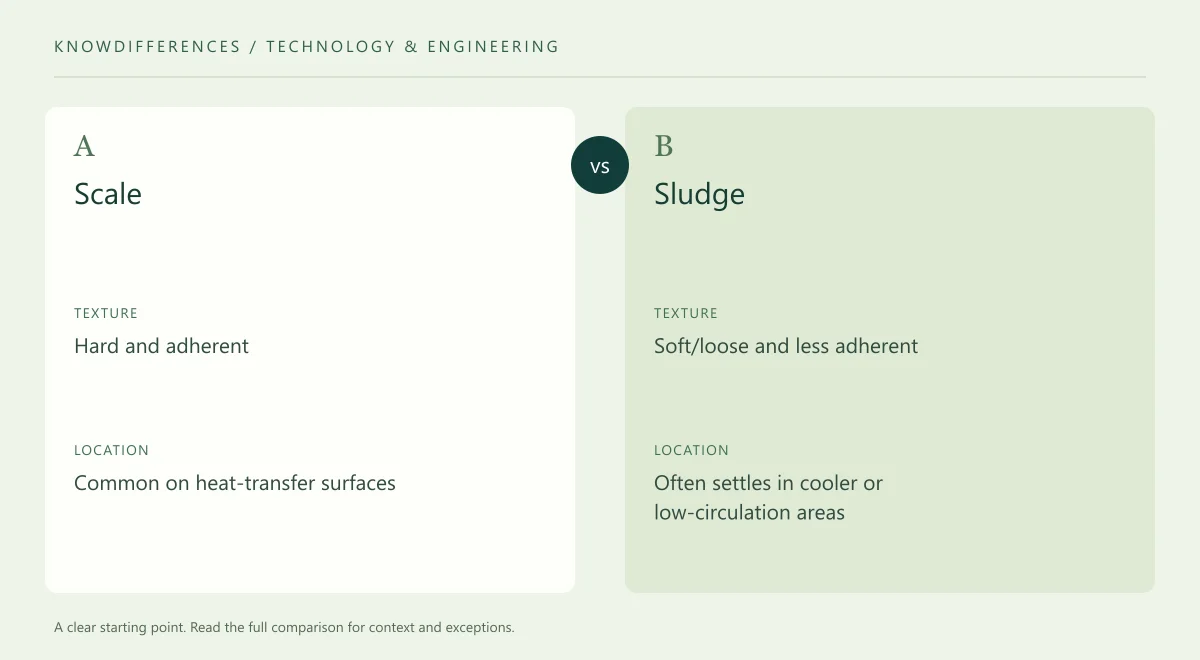
| Texture | Hard and adherent | Soft/loose and less adherent |
| Location | Common on heat-transfer surfaces | Often settles in cooler or low-circulation areas |
| Removal | May require chemical descaling or mechanical cleaning | Often more amenable to blowdown/flushing depending system |
| Heat transfer | Strong insulating effect; can cause overheating | Reduces circulation/efficiency and can foul surfaces |
| Cause | Mineral precipitation and concentration at surfaces | Precipitated/suspended solids settling out |
| Prevention | Water treatment, chemistry control, monitoring | Water treatment, solids control and appropriate blowdown |
Similarities
- Both originate from water impurities or treatment/chemistry issues.
- Both can reduce efficiency and contribute to corrosion or overheating problems.
- Both are better controlled through feedwater treatment and monitoring than by repeated emergency cleaning.
Practical examples
- A hard calcium-rich layer tightly bonded to a tube is scale.
- Soft sediment accumulating in a low-flow mud drum or bottom region is sludge.
How to distinguish them in practice
Identify the required function first, then compare ratings, operating behavior, standards and application constraints before selecting a term or component.
Common mistakes to avoid
- Choosing a component or construction method from a label alone instead of the design requirement.
- Ignoring ratings, standards, operating conditions or manufacturer specifications.
- Treating a conceptual comparison as a substitute for an engineered calculation or code requirement.
- Assuming terminology is identical across industries, countries or generations of equipment.
Frequently asked questions
Why is scale dangerous?
Scale insulates heated metal from water, raising metal temperature and potentially causing tube damage while wasting energy.
Can blowdown remove scale?
Blowdown helps control dissolved and suspended solids but established hard scale usually requires a specific cleaning treatment.
Is all boiler deposit scale?
No. Deposits can include scale, sludge, corrosion products and process contamination.
How should deposits be treated?
Use boiler-water analysis and the equipment/treatment provider’s procedure; inappropriate chemicals can damage equipment.
Bottom line
The most useful first check is texture: Scale — Hard and adherent; Sludge — Soft/loose and less adherent.
Sources and further reading
KnowDifferences Editorial Team
Independent explanations with definitions, practical examples and references. Read our editorial approach.