What is Combinational circuit?
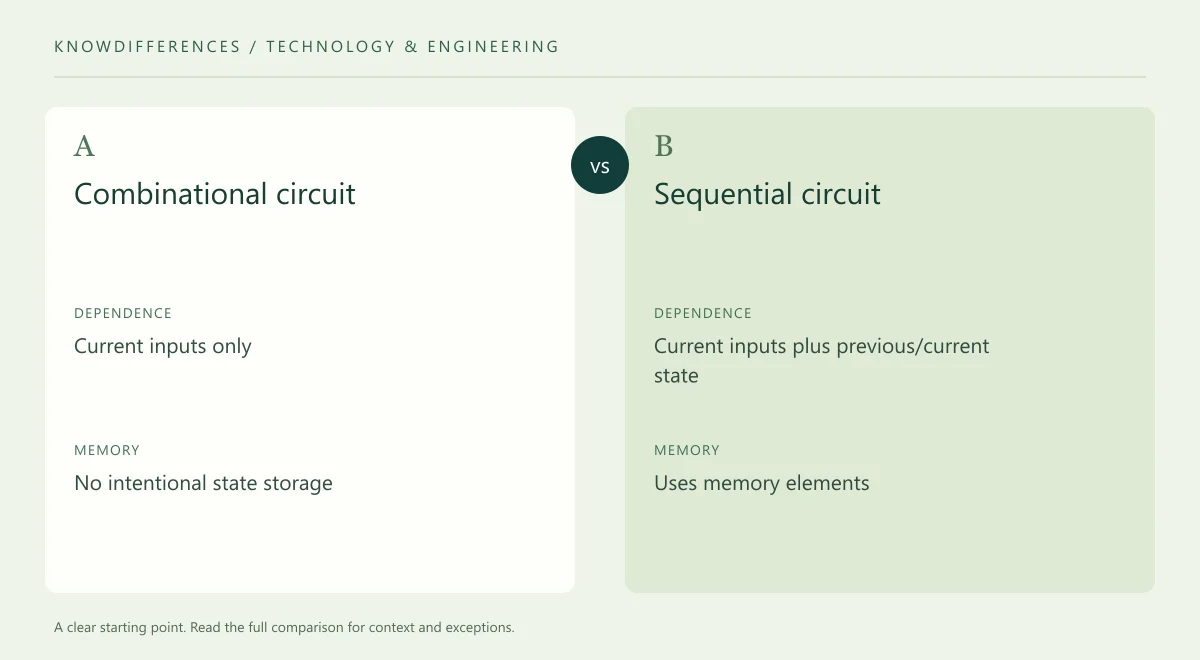
A combinational logic circuit implements a Boolean function in which the output at a given moment depends on the current combination of inputs. It does not intentionally store past state.
What is Sequential circuit?
A sequential logic circuit contains memory elements such as latches or flip-flops. Its output and next state depend on the present inputs and the circuit’s current stored state.
Combinational circuit vs Sequential circuit: comparison table
| Point of comparison | Combinational circuit | Sequential circuit |
|---|---|---|
| Dependence | Current inputs only | Current inputs plus previous/current state |
| Memory | No intentional state storage | Uses memory elements |
| Clock | Not inherently required | Many sequential designs are clocked; asynchronous designs also exist |
| Feedback | Usually not used for state | Often used as part of state behavior |
| Design model | Boolean equations/truth tables | State tables, state diagrams and Boolean logic |
| Examples | Adders, multiplexers, encoders, decoders | Counters, registers, finite-state machines |
| Timing concern | Propagation delay through logic | Propagation plus setup/hold, clock and state timing |
| Complexity | Generally simpler for the same local function | More complex because state must be controlled |
Other practical distinctions
- Timing concern: Combinational circuit: Propagation delay through logic. Sequential circuit: Propagation plus setup/hold, clock and state timing.
- Complexity: Combinational circuit: Generally simpler for the same local function. Sequential circuit: More complex because state must be controlled.
Similarities
- Both are built from digital logic elements.
- Both can be represented and optimized using Boolean logic.
- Both are fundamental building blocks of processors, controllers and digital systems.
Practical examples
- A 4-to-1 multiplexer is combinational because the selected input and select lines determine the output immediately after propagation delay.
- A binary counter is sequential because its next value depends on the value stored from the previous clock event.
How to distinguish them in practice
Identify the required function first, then compare ratings, operating behavior, standards and application constraints before selecting a term or component.
Common mistakes to avoid
- Choosing a component or construction method from a label alone instead of the design requirement.
- Ignoring ratings, standards, operating conditions or manufacturer specifications.
- Treating a conceptual comparison as a substitute for an engineered calculation or code requirement.
- Assuming terminology is identical across industries, countries or generations of equipment.
Frequently asked questions
Is an adder combinational?
A basic half-adder or full-adder is combinational. A larger system that stores accumulated results can include sequential elements.
Are all sequential circuits clocked?
No. Synchronous sequential circuits use a clock, while asynchronous sequential circuits can change state based directly on input transitions.
Why does a sequential circuit need memory?
Memory allows the circuit to represent state, making functions such as counting, sequencing and protocol control possible.
Can combinational logic exist inside a sequential circuit?
Yes. Sequential designs typically contain substantial combinational logic that computes outputs and next-state values around memory elements.
Bottom line
The most useful first check is dependence: Combinational circuit — Current inputs only; Sequential circuit — Current inputs plus previous/current state.
Sources and further reading
KnowDifferences Editorial Team
Independent explanations with definitions, practical examples and references. Read our editorial approach.