Important: Structural applications must follow the applicable building code, drawings and licensed-engineer requirements. This article is educational, not a design specification.
What is PCC?
Plain cement concrete is a mix of cementitious binder, fine aggregate, coarse aggregate and water placed without conventional reinforcing steel intended to carry structural tensile stresses. It is commonly used for leveling courses, blinding, simple mass concrete and other primarily compressive/non-reinforced applications.
What is RCC?
Reinforced cement concrete contains designed steel reinforcement—such as bars or welded reinforcement—in concrete. Concrete carries compression effectively while reinforcement provides tensile capacity and helps control cracking according to the structural design.
PCC vs RCC: comparison table
| Point of comparison | PCC | RCC |
|---|---|---|
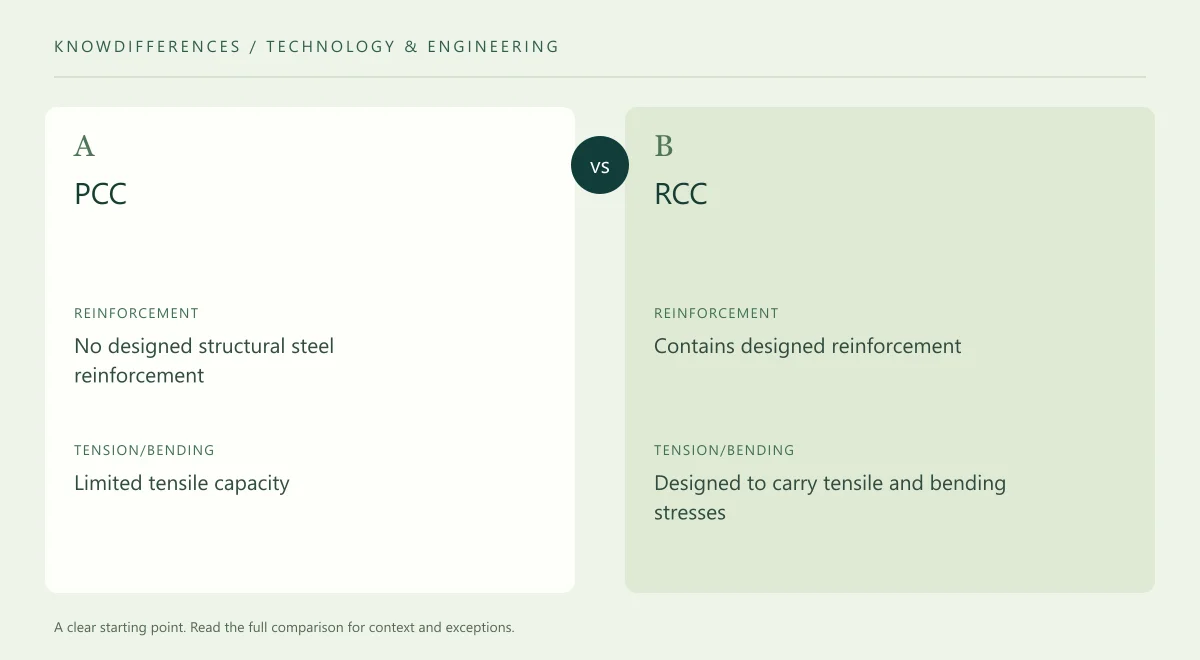
| Reinforcement | No designed structural steel reinforcement | Contains designed reinforcement |
| Tension/bending | Limited tensile capacity | Designed to carry tensile and bending stresses |
| Typical use | Blinding, leveling, non-structural beds, some mass concrete | Slabs, beams, columns, footings, walls and frames |
| Design complexity | Lower for simple applications | Requires structural design and reinforcement detailing |
| Cost | Usually lower per simple volume | Higher because of steel, labor and detailing |
| Crack behavior | More limited control under tension | Reinforcement helps control crack width and carry tension |
| Placement | Simpler when geometry is uncomplicated | Requires cover, bar spacing, anchorage and congestion control |
| Standards | Concrete/material standards still apply | Concrete plus structural reinforcement/code requirements |
Other practical distinctions
- Placement: PCC: Simpler when geometry is uncomplicated. RCC: Requires cover, bar spacing, anchorage and congestion control.
- Standards: PCC: Concrete/material standards still apply. RCC: Concrete plus structural reinforcement/code requirements.
Similarities
- Both use hydraulic cementitious concrete mixtures.
- Both require proper batching, mixing, placement, compaction and curing.
- Both can fail if water-cement ratio, curing, aggregate quality or workmanship is poor.
Practical examples
- A thin concrete blinding layer below a foundation is often PCC.
- A suspended floor slab spanning between supports is typically RCC because bending creates tensile stresses.
How to distinguish them in practice
Identify the required function first, then compare ratings, operating behavior, standards and application constraints before selecting a term or component.
Common mistakes to avoid
- Choosing a component or construction method from a label alone instead of the design requirement.
- Ignoring ratings, standards, operating conditions or manufacturer specifications.
- Treating a conceptual comparison as a substitute for an engineered calculation or code requirement.
- Assuming terminology is identical across industries, countries or generations of equipment.
Frequently asked questions
Is PCC weaker than RCC?
Not simply in compressive strength; the major distinction is that RCC is designed as a reinforced composite to carry tension and bending.
Can PCC contain any steel?
Incidental steel or fibers may be present in some specifications, but conventional “PCC vs RCC” refers to whether structural reinforcement is designed to carry tensile forces.
Why is steel used in RCC?
Steel provides tensile capacity, bonds well with concrete and has compatible thermal behavior when properly designed.
Can I choose PCC instead of RCC to save money?
Only if the structural design and applicable code permit it. Structural members should follow an engineer’s design.
Bottom line
The most useful first check is reinforcement: PCC — No designed structural steel reinforcement; RCC — Contains designed reinforcement.
Sources and further reading
KnowDifferences Editorial Team
Independent explanations with definitions, practical examples and references. Read our editorial approach.