Important: Survey practice and instrument conventions vary. Professional boundary or engineering surveys should use qualified surveyors and current standards.
What is Prismatic compass?
A prismatic compass combines magnetic bearing measurement with a prism that allows the surveyor to read the graduated ring while sighting the target. In the classic instrument the graduated ring moves with the magnetic needle system.
What is Surveyor’s compass?
A surveyor’s compass is a traditional magnetic surveying instrument with sight vanes and a compass box. In the classic form, the graduated ring is fixed to the box while the magnetic needle moves independently.
Prismatic compass vs Surveyor’s compass: comparison table
| Point of comparison | Prismatic compass | Surveyor’s compass |
|---|---|---|
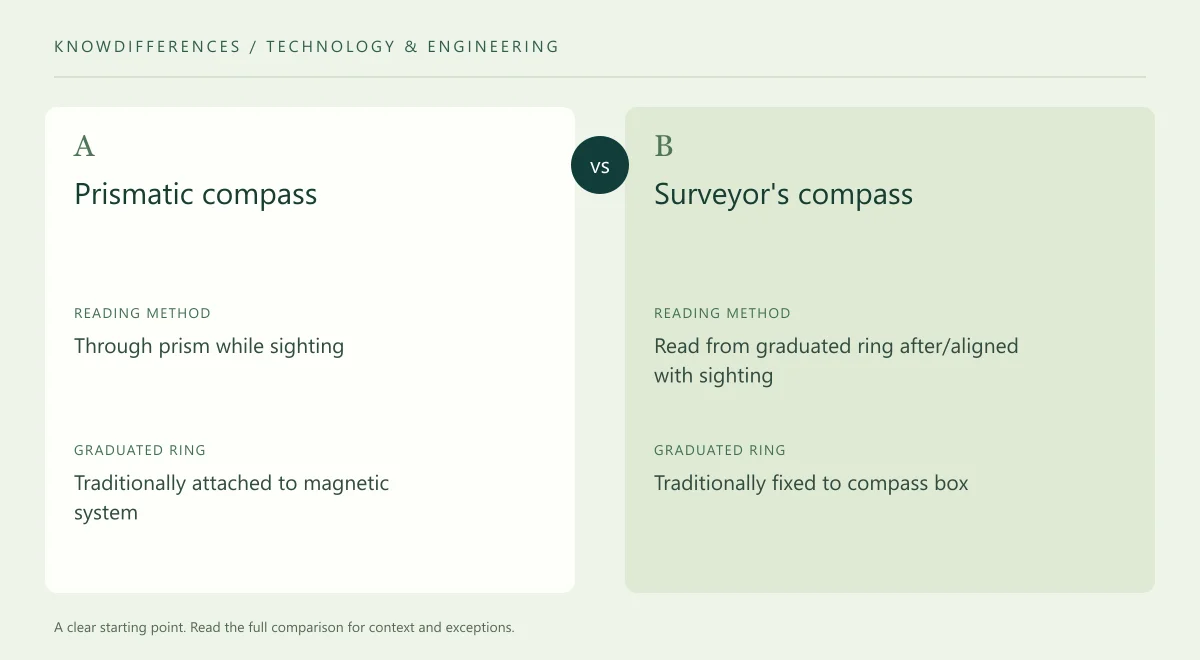
| Reading method | Through prism while sighting | Read from graduated ring after/aligned with sighting |
| Graduated ring | Traditionally attached to magnetic system | Traditionally fixed to compass box |
| Bearing system | Commonly whole-circle bearings 0–360° | Commonly quadrantal/reduced bearings |
| Sighting/read simultaneously | Yes, key advantage | Typically less direct than prism reading |
| Use | Traverse/reconnaissance magnetic surveying | Traditional magnetic surveying and bearings |
Similarities
- Both measure magnetic bearings, not true/geodetic bearings directly.
- Both are affected by magnetic declination and local attraction.
- Both have largely been superseded in precision work by modern total stations, GNSS and electronic instruments.
Practical examples
- A steel fence, vehicle or electrical installation near either compass can distort the magnetic reading and should be treated as possible local attraction.
How to distinguish them in practice
Identify the required function first, then compare ratings, operating behavior, standards and application constraints before selecting a term or component.
Common mistakes to avoid
- Choosing a component or construction method from a label alone instead of the design requirement.
- Ignoring ratings, standards, operating conditions or manufacturer specifications.
- Treating a conceptual comparison as a substitute for an engineered calculation or code requirement.
- Assuming terminology is identical across industries, countries or generations of equipment.
Frequently asked questions
Which compass uses whole-circle bearings?
The classic prismatic compass is commonly taught with whole-circle bearings.
Which is more accurate?
Accuracy depends on instrument quality, observation method and magnetic conditions; neither is a substitute for modern precision survey equipment.
What is local attraction?
It is deflection of the compass needle caused by nearby magnetic materials or fields.
Do I need to correct for magnetic declination?
Yes when converting magnetic bearings to a true/grid reference as required by the survey.
Bottom line
The most useful first check is reading method: Prismatic compass — Through prism while sighting; Surveyor’s compass — Read from graduated ring after/aligned with sighting.
Sources and further reading
KnowDifferences Editorial Team
Independent explanations with definitions, practical examples and references. Read our editorial approach.