What is BJT?
A bipolar junction transistor is a three-terminal semiconductor device—emitter, base and collector—in which both electron and hole carrier behavior is involved. In circuit design it is commonly modeled as a current-controlled/current-amplifying device, although precise behavior is described by transistor equations.
What is FET?
A field-effect transistor is a three-terminal or four-terminal device in which an electric field at the gate controls current through a semiconductor channel. MOSFETs are the most common FET family in modern digital and power electronics.
BJT vs FET: comparison table
| Point of comparison | BJT | FET |
|---|---|---|
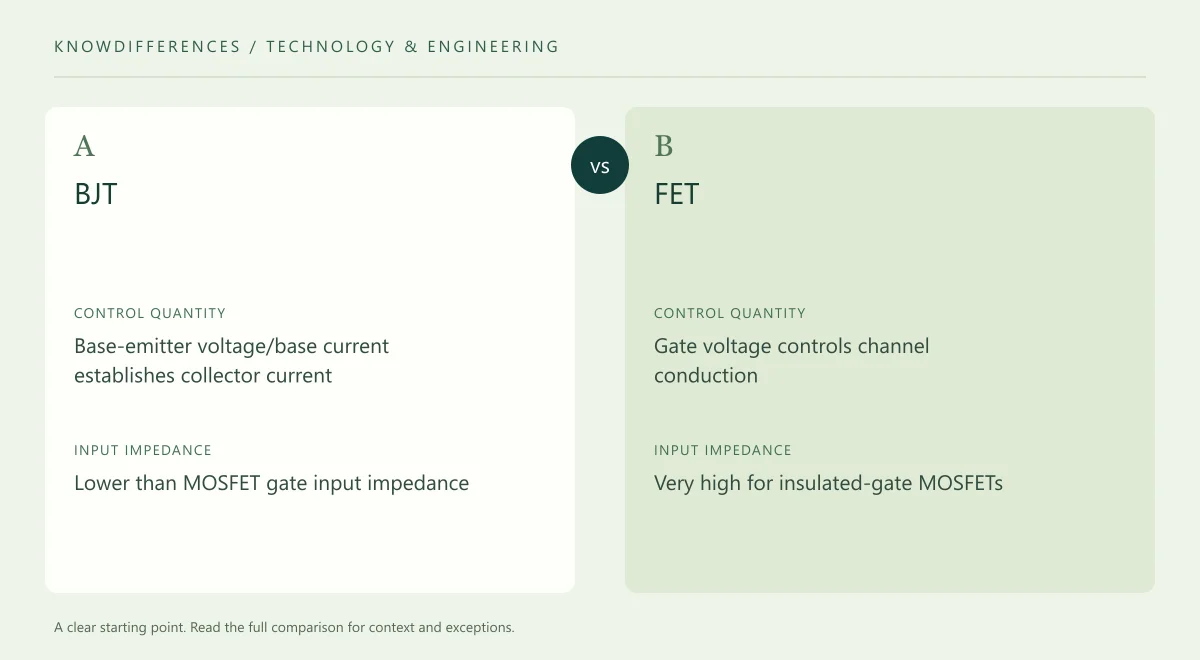
| Control quantity | Base-emitter voltage/base current establishes collector current | Gate voltage controls channel conduction |
| Input impedance | Lower than MOSFET gate input impedance | Very high for insulated-gate MOSFETs |
| Carrier type | Bipolar conduction | Majority-carrier device in common FET operation |
| Drive power | Needs continuing base drive in many uses | MOSFET gate mainly needs charge during switching |
| Thermal behavior | Can be susceptible to thermal runaway without bias control | Power MOSFETs often parallel more easily in positive-temp-coefficient region |
| Switching | Useful but charge storage can limit saturated switching | MOSFETs dominate many high-speed switching applications |
| Analog strength | High transconductance and predictable small-signal behavior | High input impedance and excellent switching/integration |
| Common examples | NPN, PNP | MOSFET, JFET |
Other practical distinctions
- Analog strength: BJT: High transconductance and predictable small-signal behavior. FET: High input impedance and excellent switching/integration.
- Common examples: BJT: NPN, PNP. FET: MOSFET, JFET.
Similarities
- Both are transistors used for switching and amplification.
- Both have three principal terminals and require correct biasing.
- Both exist in small-signal and power forms.
- Device choice depends on voltage, current, frequency, noise, efficiency and cost.
Practical examples
- A small-signal BJT may be chosen for an analog gain stage where transconductance is valuable.
- A MOSFET is commonly used to switch a motor or DC load because the gate can be driven with little steady-state current.
How to distinguish them in practice
Identify the required function first, then compare ratings, operating behavior, standards and application constraints before selecting a term or component.
Common mistakes to avoid
- Choosing a component or construction method from a label alone instead of the design requirement.
- Ignoring ratings, standards, operating conditions or manufacturer specifications.
- Treating a conceptual comparison as a substitute for an engineered calculation or code requirement.
- Assuming terminology is identical across industries, countries or generations of equipment.
Frequently asked questions
Is a MOSFET a FET?
Yes. MOSFET means metal-oxide-semiconductor field-effect transistor.
Which has higher input impedance?
An insulated-gate MOSFET normally has much higher DC input impedance than a BJT input junction.
Which is better for switching?
MOSFETs dominate many switching applications, but BJTs and IGBTs remain useful in particular voltage, current, cost and analog cases.
Is a BJT literally current controlled?
That is a useful circuit model, but transistor physics is more accurately described through base-emitter voltage and carrier transport. Designers use the model appropriate to the task.
Bottom line
The most useful first check is control quantity: BJT — Base-emitter voltage/base current establishes collector current; FET — Gate voltage controls channel conduction.
Sources and further reading
KnowDifferences Editorial Team
Independent explanations with definitions, practical examples and references. Read our editorial approach.