What is LED?
A light-emitting diode is a semiconductor p-n junction designed to emit photons through radiative recombination when carriers are injected under forward bias.
What is Photodiode?
A photodiode is a semiconductor junction optimized to detect light. Incoming photons create electron-hole pairs that produce photocurrent or a photovoltage depending on operating mode.
LED vs Photodiode: comparison table
| Point of comparison | LED | Photodiode |
|---|---|---|
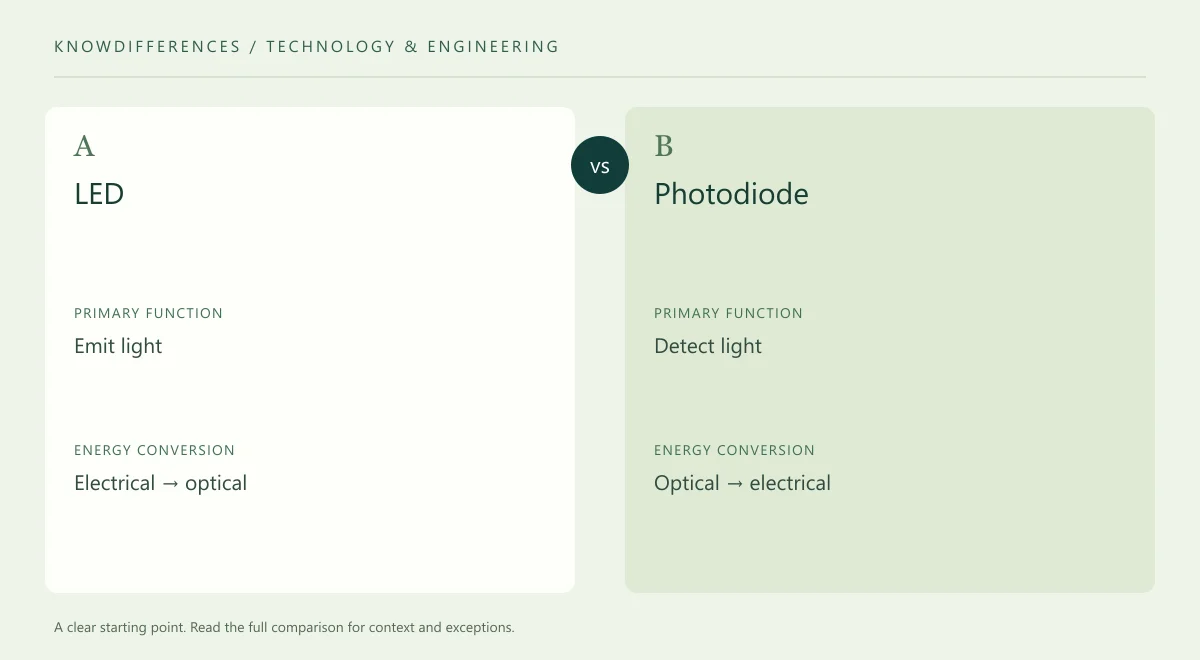
| Primary function | Emit light | Detect light |
| Energy conversion | Electrical → optical | Optical → electrical |
| Typical bias | Forward bias | Reverse bias for speed/linearity or zero bias for photovoltaic operation |
| Output/input | Light output driven by current | Photocurrent/voltage driven by incident light |
| Materials | Chosen for emission wavelength | Chosen for spectral response and detection |
| Applications | Indicators, lighting, displays, optical transmitters | Sensors, optical receivers, light meters |
Similarities
- Both are semiconductor junction devices.
- Both are wavelength-dependent because semiconductor bandgap matters.
- Both are widely used together in optocouplers and optical communication links.
Practical examples
- An infrared remote-control transmitter uses an IR LED; the receiver may use a photodiode or phototransistor.
How to distinguish them in practice
Identify the required function first, then compare ratings, operating behavior, standards and application constraints before selecting a term or component.
Common mistakes to avoid
- Choosing a component or construction method from a label alone instead of the design requirement.
- Ignoring ratings, standards, operating conditions or manufacturer specifications.
- Treating a conceptual comparison as a substitute for an engineered calculation or code requirement.
- Assuming terminology is identical across industries, countries or generations of equipment.
Frequently asked questions
Can an LED detect light?
Some LEDs show a weak photovoltaic/detection response, but purpose-built photodiodes are far better optimized for detection.
Why reverse-bias a photodiode?
Reverse bias widens the depletion region and can reduce capacitance, improving speed; it also increases dark current/noise considerations.
What is photovoltaic mode?
The photodiode operates with little or no external reverse bias and generates a light-dependent voltage/current.
Is a solar cell a photodiode?
A solar cell is a large-area photovoltaic semiconductor junction optimized for power generation rather than high-speed sensing.
Bottom line
The most useful first check is primary function: LED — Emit light; Photodiode — Detect light.
Sources and further reading
KnowDifferences Editorial Team
Independent explanations with definitions, practical examples and references. Read our editorial approach.