Important: Medical information only. Do not self-cut foot lesions. High-risk feet require clinician/podiatry guidance.
What is Wart?
A common or plantar wart is a benign epidermal growth caused by HPV infection. Plantar warts on weight-bearing areas can be flattened inward by pressure and may be painful.
What is Callus?
A callus is a broad area of thickened keratinized skin that develops as protection against repeated friction or pressure, often on feet or hands.
Wart vs Callus: comparison table
| Point of comparison | Wart | Callus |
|---|---|---|
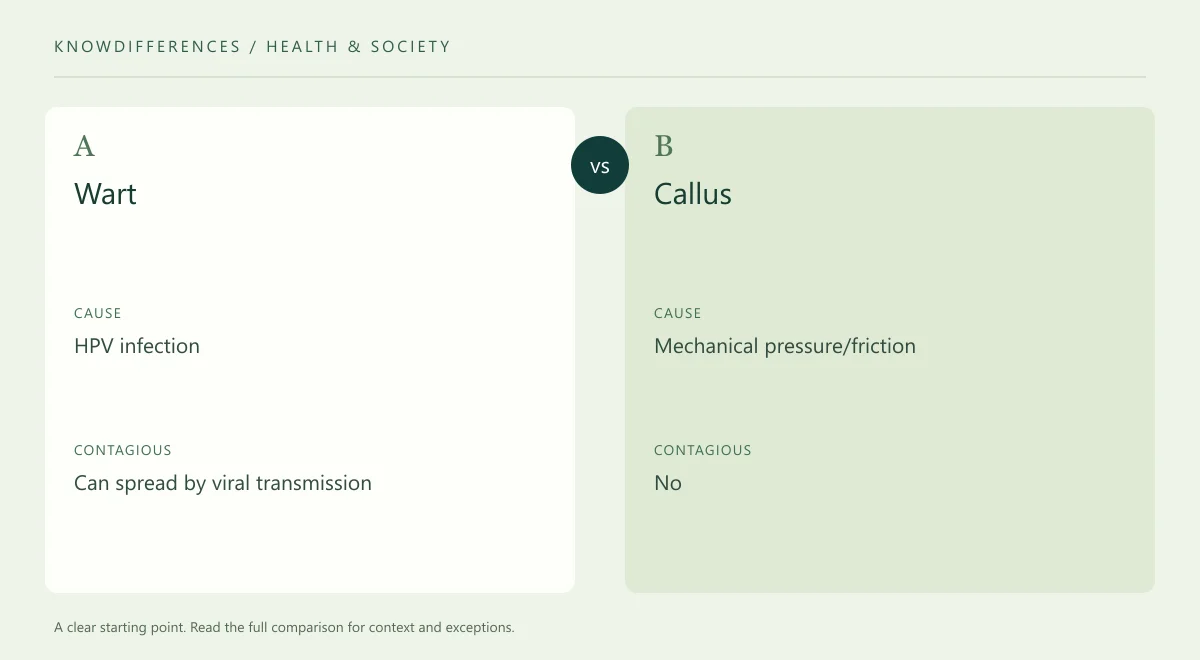
| Cause | HPV infection | Mechanical pressure/friction |
| Contagious | Can spread by viral transmission | No |
| Skin lines | Often interrupted | Usually continue through lesion |
| Dark dots | May show tiny thrombosed capillary dots | Typically absent |
| Pressure pattern | Can occur beyond classic pressure points | Usually matches repetitive pressure area |
| Treatment aim | Remove/clear infected tissue or support immune resolution | Reduce pressure/friction and soften excess skin |
Similarities
- Both can appear as rough thickened skin.
- Both can be painful on the sole under pressure.
- Self-cutting with blades can cause injury or infection and is unsafe, especially with diabetes or poor circulation.
Practical examples
- A rough plantar lesion with interrupted skin lines and pinpoint black dots is more suspicious for a wart.
- Diffuse thick skin under a repeatedly loaded metatarsal head is more consistent with callus.
How to distinguish them in practice
Use the comparison to understand terminology, not to diagnose yourself or another person. Clinical context and professional assessment can change the answer.
Common mistakes to avoid
- Trying to self-diagnose from one visible feature or symptom.
- Ignoring severity, duration, cause and other clinical context.
- Using broad social or medical terminology as a label for a specific person without appropriate assessment.
- Delaying professional or emergency help when symptoms, injury or safety concerns require it.
Frequently asked questions
Can a callus spread to another person?
No. A mechanical callus is not infectious.
Can a wart look like a callus?
Yes, especially a plantar wart flattened by body weight.
Should I use salicylic acid?
It is common for warts/corns but is not appropriate for everyone; avoid self-treatment in high-risk feet unless a clinician advises it.
When should a lesion be checked?
If diagnosis is uncertain, it bleeds, changes, ulcerates, persists despite care, or you have diabetes, neuropathy or poor circulation.
Bottom line
The most useful first check is cause: Wart — HPV infection; Callus — Mechanical pressure/friction.
Sources and further reading
KnowDifferences Editorial Team
Independent explanations with definitions, practical examples and references. Read our editorial approach.