Important: Medical information only, not diagnosis. People with diabetes, poor circulation, neuropathy, ulcers or severe pain should seek professional foot care promptly.
What is Hammer toe?
Hammer toe is a deformity, usually of the second through fifth toes, characterized primarily by bending at the proximal interphalangeal joint. Early deformities may remain flexible; later ones can become rigid.
What is Claw toe?
Claw toe involves hyperextension at the toe’s metatarsophalangeal joint together with flexion at the interphalangeal joints. It can be associated with muscle imbalance, neurologic conditions or longstanding footwear/mechanical problems.
Hammer toe vs Claw toe: comparison table
| Point of comparison | Hammer toe | Claw toe |
|---|---|---|
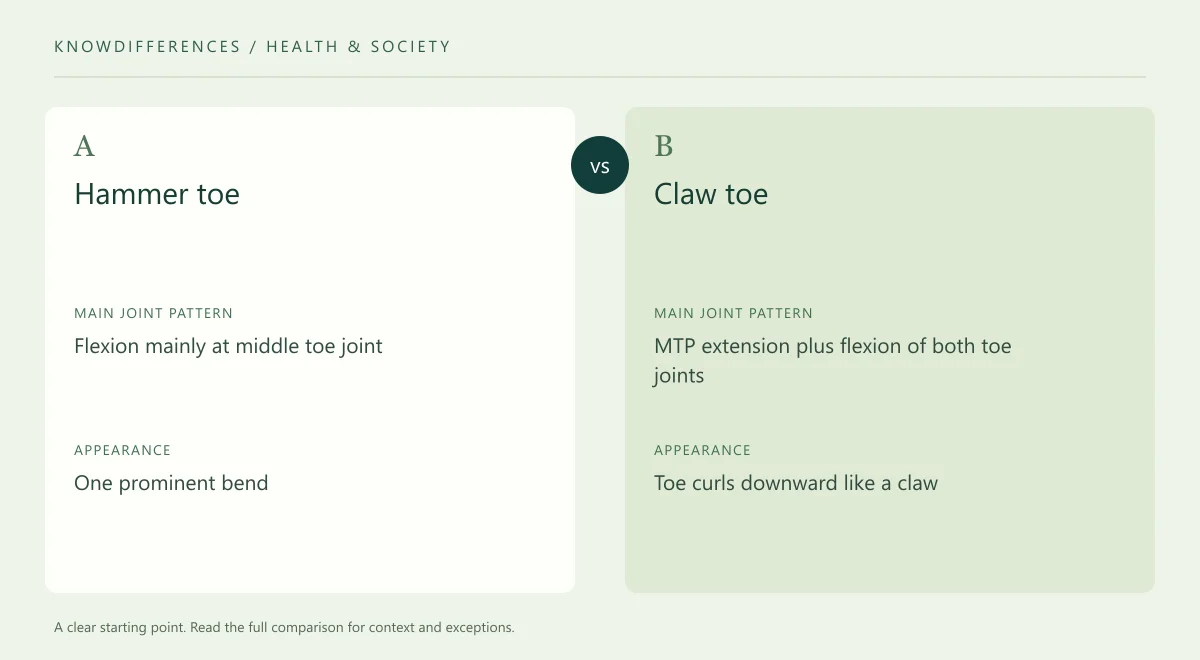
| Main joint pattern | Flexion mainly at middle toe joint | MTP extension plus flexion of both toe joints |
| Appearance | One prominent bend | Toe curls downward like a claw |
| Number affected | Often one or several toes | Often multiple toes |
| Pressure areas | Top of bent joint, tip/ball depending shoe | Top of toes, tips and ball of foot |
| Underlying factors | Footwear, tendon imbalance, anatomy | Muscle imbalance, neurologic/mechanical causes among possibilities |
| Treatment | Footwear, pads, exercises/orthoses; surgery if severe | Cause-directed care, footwear/orthoses; surgery in selected rigid cases |
Similarities
- Both are deformities of the lesser toes.
- Both can cause corns, calluses, shoe pressure and pain.
- Flexible deformities are generally easier to accommodate than rigid ones.
Practical examples
- A second toe bent chiefly at the middle joint is more typical of hammer toe.
- Several toes pulled upward at their bases and curled downward at both joints are more suggestive of claw toes.
How to distinguish them in practice
Use the comparison to understand terminology, not to diagnose yourself or another person. Clinical context and professional assessment can change the answer.
Common mistakes to avoid
- Trying to self-diagnose from one visible feature or symptom.
- Ignoring severity, duration, cause and other clinical context.
- Using broad social or medical terminology as a label for a specific person without appropriate assessment.
- Delaying professional or emergency help when symptoms, injury or safety concerns require it.
Flexible vs rigid deformity
Early deformities may still straighten when the toe is manipulated. Over time, joints and soft tissues can stiffen, making the position fixed.
This distinction affects treatment options and is one reason to seek assessment before severe shoe pressure or wounds develop.
Conservative treatment
Wider toe-box footwear, pressure relief, toe pads, stretching and addressing biomechanical contributors can reduce symptoms in selected cases. Treatment should avoid devices that increase pressure or compromise circulation.
People with diabetes, neuropathy or poor circulation should obtain professional foot care rather than self-treating corns aggressively.
When surgery is considered
Persistent painful rigid deformity may be treated surgically after non-operative options fail. The procedure depends on joint flexibility, tendon balance, MTP stability and the overall forefoot.
Frequently asked questions
Can hammer toe become rigid?
Yes. A flexible deformity can become fixed over time.
Are tight shoes the only cause?
No. Footwear can contribute, but anatomy, tendon imbalance, arthritis, trauma and neurologic conditions can also matter.
When should I see a clinician?
Seek assessment for persistent pain, ulcers, numbness, rapid progression, diabetes-related foot risk or difficulty walking.
Can exercises cure it?
Exercises and footwear changes may help flexible deformities and symptoms, but established structural deformity may not fully reverse.
Bottom line
The most useful first check is main joint pattern: Hammer toe — Flexion mainly at middle toe joint; Claw toe — MTP extension plus flexion of both toe joints.
Sources and further reading
KnowDifferences Editorial Team
Independent explanations with definitions, practical examples and references. Read our editorial approach.