Important: If you or someone else is in immediate danger, contact local emergency services. Definitions also vary by law and professional context; this page is general educational information.
What is Violence?
Violence is commonly defined in public-health contexts as the intentional use of physical force or power, threatened or actual, that results in or has a high likelihood of resulting in injury, death, psychological harm, maldevelopment or deprivation.
What is Abuse?
Abuse is harmful or exploitative treatment of a person and can take physical, sexual, emotional/psychological, financial and other forms. In relationships it may include repeated coercion, intimidation, isolation or control even when no physical assault occurs.
Violence vs Abuse: comparison table
| Point of comparison | Violence | Abuse |
|---|---|---|
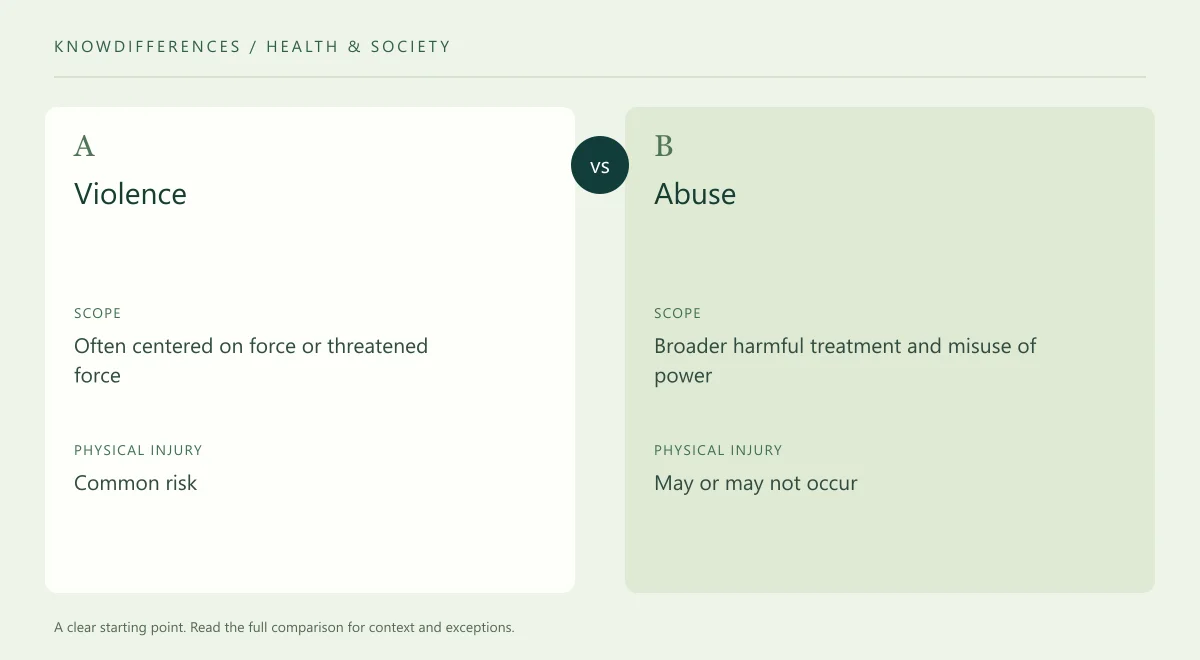
| Scope | Often centered on force or threatened force | Broader harmful treatment and misuse of power |
| Physical injury | Common risk | May or may not occur |
| Psychological control | Can be part of violence | Can be central even without physical force |
| Financial control | Not usually described as physical violence | Can be a form of abuse |
| Sexual harm | Can be violent | Can constitute sexual abuse |
| Pattern | Can be a single event or repeated | Often discussed as a pattern, though a single act can be abusive |
| Context | Interpersonal, community, institutional or collective | Commonly interpersonal/caregiving/institutional; definitions vary |
Other practical distinctions
- Context: Violence: Interpersonal, community, institutional or collective. Abuse: Commonly interpersonal/caregiving/institutional; definitions vary.
Similarities
- Both can cause serious physical and psychological harm.
- Both can involve threats, coercion and power imbalance.
- Neither should be minimized because visible injury is absent.
Practical examples
- Punching or physically attacking a partner is both violence and physical abuse.
- Repeatedly controlling a partner’s money, contacts and movement can be abuse even if physical violence has not occurred.
How to distinguish them in practice
Use the comparison to understand terminology, not to diagnose yourself or another person. Clinical context and professional assessment can change the answer.
Common mistakes to avoid
- Trying to self-diagnose from one visible feature or symptom.
- Ignoring severity, duration, cause and other clinical context.
- Using broad social or medical terminology as a label for a specific person without appropriate assessment.
- Delaying professional or emergency help when symptoms, injury or safety concerns require it.
Frequently asked questions
Can abuse occur without violence?
Yes. Emotional, financial and coercive abuse can occur without physical force.
Is all violence abuse?
Interpersonal violence against a partner, child or vulnerable person is commonly abusive, but the terms are used differently across public-health, legal and social contexts.
Can a single incident be abuse?
Yes. Some forms of abuse can occur in a single incident, while others are identified through a pattern of behavior.
What should someone do if they are in immediate danger?
Contact local emergency services or a trusted domestic-violence/abuse support organization where it is safe to do so.
Bottom line
The most useful first check is scope: Violence — Often centered on force or threatened force; Abuse — Broader harmful treatment and misuse of power.
Sources and further reading
KnowDifferences Editorial Team
Independent explanations with definitions, practical examples and references. Read our editorial approach.