Important: Medical information only. Avoid medicated corn removers or self-cutting if you have diabetes, neuropathy or poor circulation unless specifically advised by a clinician.
What is Corn?
A corn is a localized area of hyperkeratosis caused by concentrated pressure or friction. Hard corns commonly occur on toe joints; soft corns can develop between toes where moisture changes the skin texture.
What is Callus?
A callus is a broader thickened area of skin caused by repeated mechanical stress. It commonly develops on the soles, palms or other pressure-bearing surfaces.
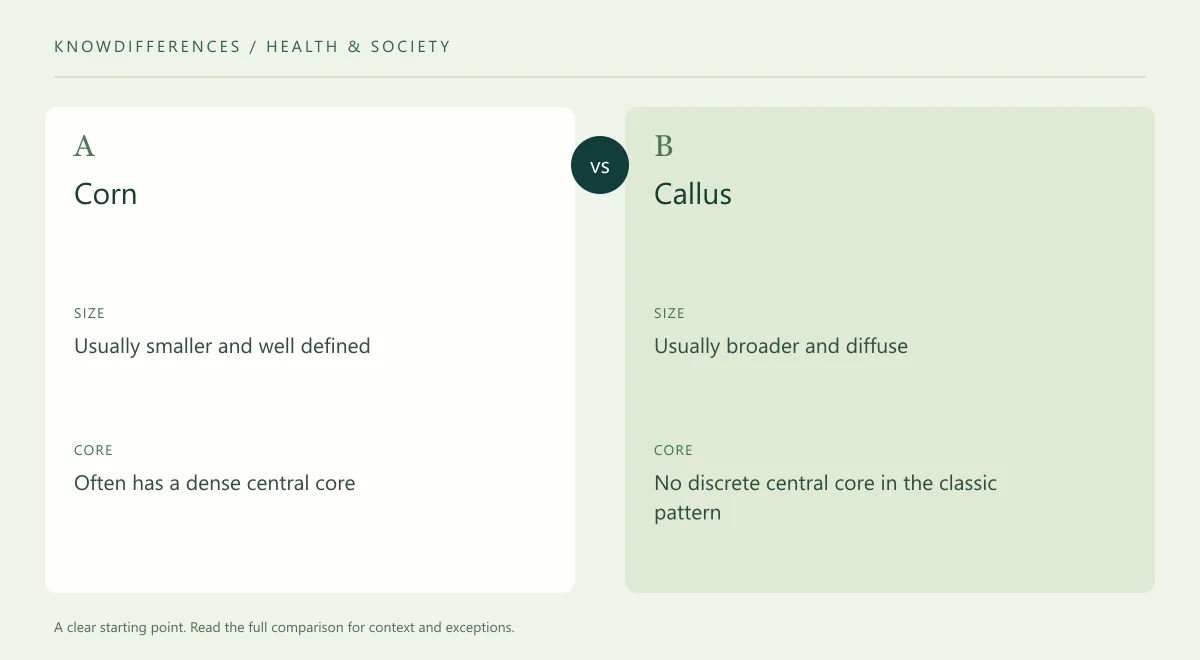
Corn vs Callus: comparison table
| Point of comparison | Corn | Callus |
|---|---|---|
| Size | Usually smaller and well defined | Usually broader and diffuse |
| Core | Often has a dense central core | No discrete central core in the classic pattern |
| Location | Tops/sides of toes or between toes | Balls/heels of feet, palms and other pressure areas |
| Pain | Can be quite tender with direct pressure | Often less focal, though can hurt if thick |
| Cause | Localized shoe/bony pressure | Repeated broader friction/pressure |
| Treatment focus | Relieve focal pressure and treat underlying cause | Reduce repeated load/friction and manage thick skin safely |
Similarities
- Both are protective thickening responses to mechanical stress.
- Neither is contagious.
- Both can recur if the underlying pressure remains.
Practical examples
- A small painful hard spot over a bent toe joint is typical of a corn.
- A wide yellowish thickened patch beneath the forefoot is typical of a callus.
How to distinguish them in practice
Use the comparison to understand terminology, not to diagnose yourself or another person. Clinical context and professional assessment can change the answer.
Common mistakes to avoid
- Trying to self-diagnose from one visible feature or symptom.
- Ignoring severity, duration, cause and other clinical context.
- Using broad social or medical terminology as a label for a specific person without appropriate assessment.
- Delaying professional or emergency help when symptoms, injury or safety concerns require it.
Why they return
Removing thick skin without fixing the pressure source gives only temporary relief. Shoes, toe deformities, gait, occupational friction and sports equipment can recreate the same loading pattern.
A recurring corn is therefore a clue to look at footwear and biomechanics.
Soft corns
Corns between toes can remain moist and whitish because of sweat and close skin contact. These are called soft corns and commonly occur where two toe bones rub.
Keeping the area dry and reducing toe-to-toe pressure can help.
Safe management
Gentle filing after bathing and moisturizers can help simple callus in healthy skin. Purpose-made padding can reduce pressure. Strong corn-remover acids and blades carry more risk, especially if sensation or circulation is impaired.
Frequently asked questions
Are corns warts?
No. Corns are mechanical thickening; warts are caused by HPV.
Can I cut a corn out myself?
Do not cut it with a blade. This can cause wounds or infection.
Why do corns return?
Because the shoe pressure, toe deformity or load pattern that caused them may still be present.
When is professional care important?
For diabetes, neuropathy, poor circulation, ulcers, infection, severe pain or uncertain diagnosis.
Bottom line
The most useful first check is size: Corn — Usually smaller and well defined; Callus — Usually broader and diffuse.
Sources and further reading
KnowDifferences Editorial Team
Independent explanations with definitions, practical examples and references. Read our editorial approach.