What is Plant cell?
A plant cell is a eukaryotic cell surrounded by a plasma membrane and, outside it, a cellulose-rich cell wall. Many plant cells contain a large central vacuole and photosynthetic cells contain chloroplasts.
What is Animal cell?
An animal cell is a eukaryotic cell enclosed by a plasma membrane without a rigid cellulose cell wall. Animal cell shape and organelle arrangement vary greatly by tissue and function.
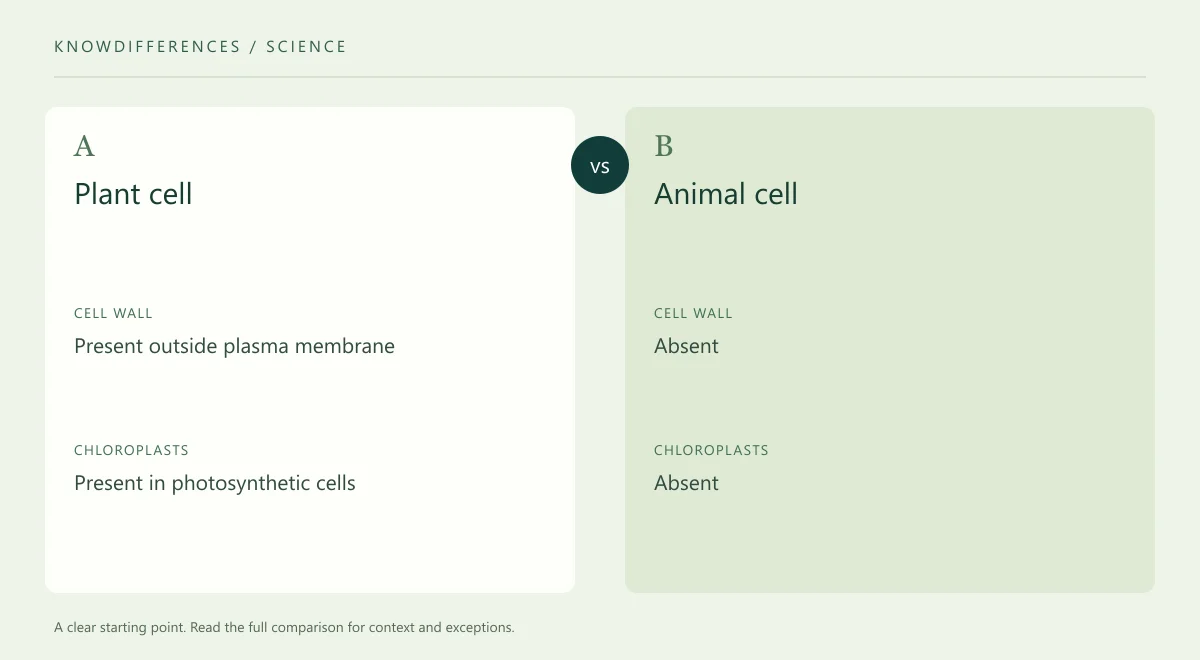
Plant cell vs Animal cell: comparison table
| Point of comparison | Plant cell | Animal cell |
|---|---|---|
| Cell wall | Present outside plasma membrane | Absent |
| Chloroplasts | Present in photosynthetic cells | Absent |
| Central vacuole | Typically one large central vacuole in mature cells | Usually smaller vesicles/vacuoles |
| Shape | Often constrained by rigid wall | More variable/flexible |
| Centrioles | Not universal in higher plant somatic cells | Common in animal centrosomes |
| Cytokinesis | Cell plate forms new wall | Cleavage furrow commonly forms |
| Energy organelle | Mitochondria present | Mitochondria present |
| Nucleus | Present in typical living cells, with exceptions by cell type | Present in typical cells, with specialized exceptions such as mature mammalian red cells |
Other practical distinctions
- Energy organelle: Plant cell: Mitochondria present. Animal cell: Mitochondria present.
- Nucleus: Plant cell: Present in typical living cells, with exceptions by cell type. Animal cell: Present in typical cells, with specialized exceptions such as mature mammalian red cells.
Similarities
- Both have DNA in a nucleus in typical eukaryotic cells.
- Both contain ribosomes, endoplasmic reticulum, Golgi apparatus, cytoskeleton and mitochondria.
- Both use plasma membranes to regulate transport.
Practical examples
- A leaf mesophyll cell contains chloroplasts for photosynthesis.
- A human muscle cell lacks chloroplasts but contains many mitochondria to support energy demand.
How to distinguish them in practice
Start with the defining biological, chemical or physical principle, then use the table to connect that principle to observable consequences.
Common mistakes to avoid
- Memorizing a single difference without understanding the underlying structure or process.
- Treating a classroom simplification as a rule with no exceptions.
- Mixing levels of comparison, such as comparing a structure on one side with a process on the other.
- Using an unlabeled diagram or definition without checking standard scientific terminology.
Frequently asked questions
Do all plant cells have chloroplasts?
No. Roots and many non-photosynthetic tissues lack functional chloroplasts.
Do animal cells have vacuoles?
They can contain small vacuoles/vesicles, but not the large central vacuole characteristic of many mature plant cells.
Do plant cells have mitochondria?
Yes. Plants perform cellular respiration as well as photosynthesis.
Why do plant cells have a wall?
The wall provides mechanical support, protection and resistance to excessive expansion under turgor pressure.
Bottom line
The most useful first check is cell wall: Plant cell — Present outside plasma membrane; Animal cell — Absent.
Sources and further reading
KnowDifferences Editorial Team
Independent explanations with definitions, practical examples and references. Read our editorial approach.