What is Angiosperm?
An angiosperm is a flowering plant in which ovules are enclosed within an ovary. After fertilization, the ovary commonly develops into a fruit that contains the seeds.
What is Gymnosperm?
A gymnosperm is a seed plant whose ovules are not enclosed in an ovary. In many familiar gymnosperms such as conifers, seeds develop on cone scales.
Angiosperm vs Gymnosperm: comparison table
| Point of comparison | Angiosperm | Gymnosperm |
|---|---|---|
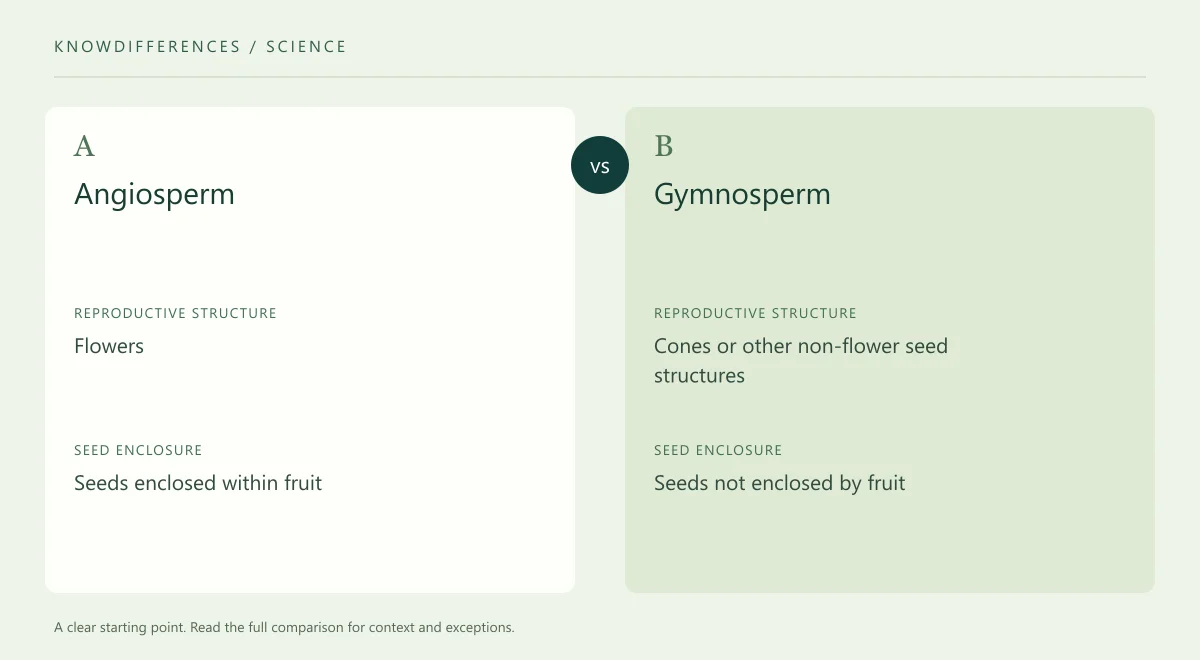
| Reproductive structure | Flowers | Cones or other non-flower seed structures |
| Seed enclosure | Seeds enclosed within fruit | Seeds not enclosed by fruit |
| Ovary | Present | Absent |
| Fruit | Produced after ovary development | Not produced |
| Double fertilization | Characteristic of angiosperms | Absent in the angiosperm sense |
| Examples | Roses, grasses, beans, oaks | Pines, firs, cycads, ginkgo |
| Vascular tissue | Typically has vessels in xylem as well as tracheids | Most rely mainly on tracheids; exceptions exist |
| Diversity | Largest and most diverse land-plant group | Much smaller group |
Other practical distinctions
- Vascular tissue: Angiosperm: Typically has vessels in xylem as well as tracheids. Gymnosperm: Most rely mainly on tracheids; exceptions exist.
- Diversity: Angiosperm: Largest and most diverse land-plant group. Gymnosperm: Much smaller group.
Similarities
- Both are vascular seed plants.
- Both produce pollen and ovules.
- Both have dominant sporophyte generations.
- Both include woody species and can reproduce without free-standing water for sperm movement in the way many non-seed plants require.
Practical examples
- An apple tree is an angiosperm: it makes flowers and the ovary becomes an apple containing seeds.
- A pine is a gymnosperm: it produces pollen cones and seed cones rather than flowers and fruits.
How to distinguish them in practice
Start with the defining biological, chemical or physical principle, then use the table to connect that principle to observable consequences.
Common mistakes to avoid
- Memorizing a single difference without understanding the underlying structure or process.
- Treating a classroom simplification as a rule with no exceptions.
- Mixing levels of comparison, such as comparing a structure on one side with a process on the other.
- Using an unlabeled diagram or definition without checking standard scientific terminology.
Frequently asked questions
Are all flowering plants angiosperms?
Yes. Flowering plants are angiosperms.
Do gymnosperms make fruit?
No true fruit forms because gymnosperms do not enclose ovules in an ovary.
Is a pine tree a gymnosperm?
Yes. Pines are conifers, one of the best-known gymnosperm groups.
Which group is more diverse?
Angiosperms are far more diverse in living species and ecological forms.
Bottom line
The most useful first check is reproductive structure: Angiosperm — Flowers; Gymnosperm — Cones or other non-flower seed structures.
Sources and further reading
KnowDifferences Editorial Team
Independent explanations with definitions, practical examples and references. Read our editorial approach.