What is Phototropism?
Phototropism is a directional growth response to light. Shoots commonly show positive phototropism by growing toward a light source, mediated by unequal growth signaling and cell elongation.
What is Heliotropism?
Heliotropism is movement or orientation of plant organs in relation to the sun’s position. Leaves or flowers may track the sun during the day through changes in cell turgor or growth, depending on species and organ.
Phototropism vs Heliotropism: comparison table
| Point of comparison | Phototropism | Heliotropism |
|---|---|---|
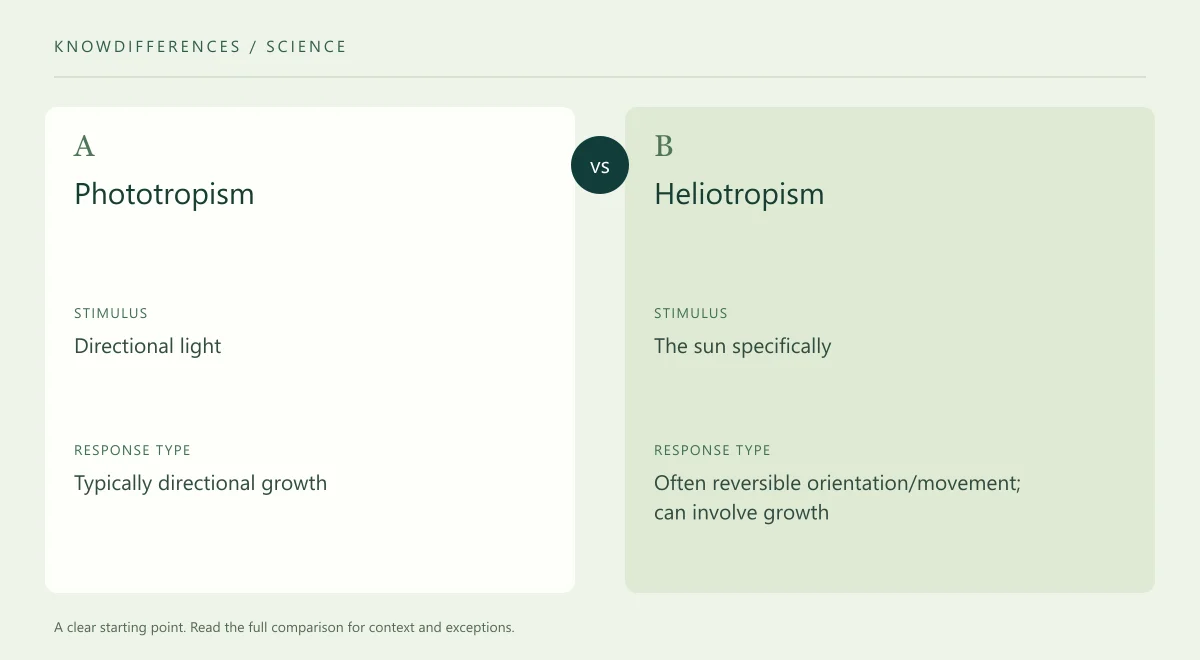
| Stimulus | Directional light | The sun specifically |
| Response type | Typically directional growth | Often reversible orientation/movement; can involve growth |
| Time scale | Growth response, generally persistent | Can change through the day |
| Example | Seedling bends toward a window | Young sunflower head or leaves orient toward sun during part of development |
| Mechanism | Differential growth and plant signaling | Turgor-driven or growth-driven movement depending species |
Similarities
- Both help plants optimize interactions with light.
- Both are directional responses rather than random movement.
- Hormonal and physiological mechanisms vary by species and developmental stage.
Practical examples
- A houseplant stem curving toward a lamp demonstrates phototropism.
- A leaf changing orientation as the sun moves across the sky is heliotropic behavior.
How to distinguish them in practice
Start with the defining biological, chemical or physical principle, then use the table to connect that principle to observable consequences.
Common mistakes to avoid
- Memorizing a single difference without understanding the underlying structure or process.
- Treating a classroom simplification as a rule with no exceptions.
- Mixing levels of comparison, such as comparing a structure on one side with a process on the other.
- Using an unlabeled diagram or definition without checking standard scientific terminology.
Frequently asked questions
Is heliotropism a type of phototropism?
They are related light-response concepts, but heliotropism usually refers specifically to sun tracking and can be reversible movement rather than growth.
Do mature sunflowers track the sun?
Young sunflower heads show solar tracking during development; mature flowering heads generally become fixed, commonly facing east.
Is phototropism only toward light?
No. Positive phototropism is toward light and negative phototropism is away from it.
Do roots show phototropism?
Some roots respond to light, but root directional growth is more strongly associated with gravity and other environmental cues.
Bottom line
The most useful first check is stimulus: Phototropism — Directional light; Heliotropism — The sun specifically.
Sources and further reading
KnowDifferences Editorial Team
Independent explanations with definitions, practical examples and references. Read our editorial approach.