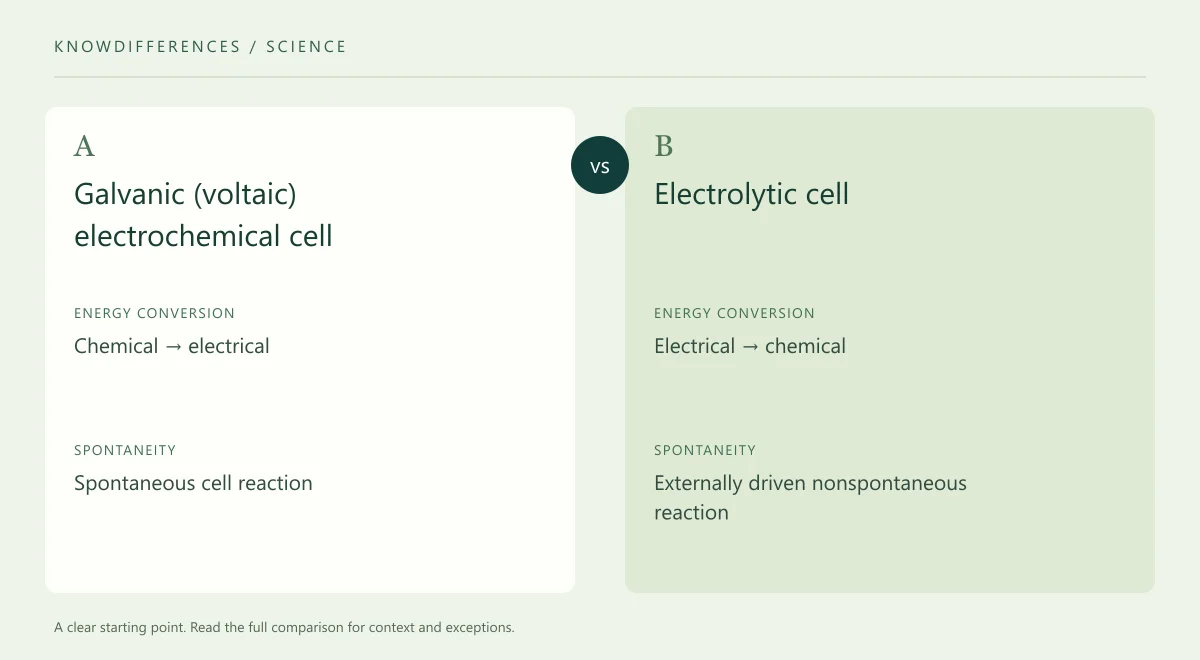
What is Galvanic (voltaic) electrochemical cell?
A galvanic cell separates a spontaneous oxidation-reduction reaction so electrons flow through an external circuit, converting chemical free energy into electrical energy.
What is Electrolytic cell?
An electrolytic cell uses an external power source to force a redox reaction that would not proceed spontaneously in the desired direction under the given conditions.
Galvanic (voltaic) electrochemical cell vs Electrolytic cell: comparison table
| Point of comparison | Galvanic (voltaic) electrochemical cell | Electrolytic cell |
|---|---|---|
| Energy conversion | Chemical → electrical | Electrical → chemical |
| Spontaneity | Spontaneous cell reaction | Externally driven nonspontaneous reaction |
| External source | Not required to produce current | Required to drive reaction |
| Electrode sign | Anode negative, cathode positive in a galvanic cell | Anode positive, cathode negative in an electrolytic cell |
| Oxidation/reduction | Oxidation at anode; reduction at cathode | Same rule: oxidation at anode; reduction at cathode |
| Uses | Batteries/fuel-cell principles | Electroplating, electrorefining, electrolysis |
Similarities
- Both involve oxidation at the anode and reduction at the cathode.
- Both move electrons through an external path and ions through an electrolyte.
- Both are governed by redox thermodynamics and electrode potentials.
Practical examples
- A discharging Daniell cell is galvanic.
- Electroplating a metal object with an externally powered bath is electrolytic.
How to distinguish them in practice
Start with the defining biological, chemical or physical principle, then use the table to connect that principle to observable consequences.
Common mistakes to avoid
- Memorizing a single difference without understanding the underlying structure or process.
- Treating a classroom simplification as a rule with no exceptions.
- Mixing levels of comparison, such as comparing a structure on one side with a process on the other.
- Using an unlabeled diagram or definition without checking standard scientific terminology.
Frequently asked questions
Is an electrolytic cell an electrochemical cell?
Yes. Electrochemical cell is the umbrella term.
Does the anode always mean negative?
No. The anode is defined by oxidation. Its sign is negative in a galvanic cell and positive in an electrolytic cell.
Does reduction always happen at the cathode?
Yes, by definition.
Can a rechargeable battery act as both?
Conceptually yes: during discharge it operates galvanically; charging uses external electrical energy to drive the reverse chemistry.
Bottom line
The most useful first check is energy conversion: Galvanic (voltaic) electrochemical cell — Chemical → electrical; Electrolytic cell — Electrical → chemical.
Sources and further reading
KnowDifferences Editorial Team
Independent explanations with definitions, practical examples and references. Read our editorial approach.