Important: General legal education only. Criminal-law definitions and defenses vary by jurisdiction.
What is Homicide?
Homicide is a broad term for one person causing the death of another. Depending on the circumstances and jurisdiction, a homicide may be criminal, justified, excused or otherwise classified under law.
What is Murder?
Murder is a criminal offense involving an unlawful killing with the culpable mental state required by the jurisdiction. Degrees and elements vary widely by country and state.
Homicide vs Murder: comparison table
| Point of comparison | Homicide | Murder |
|---|---|---|
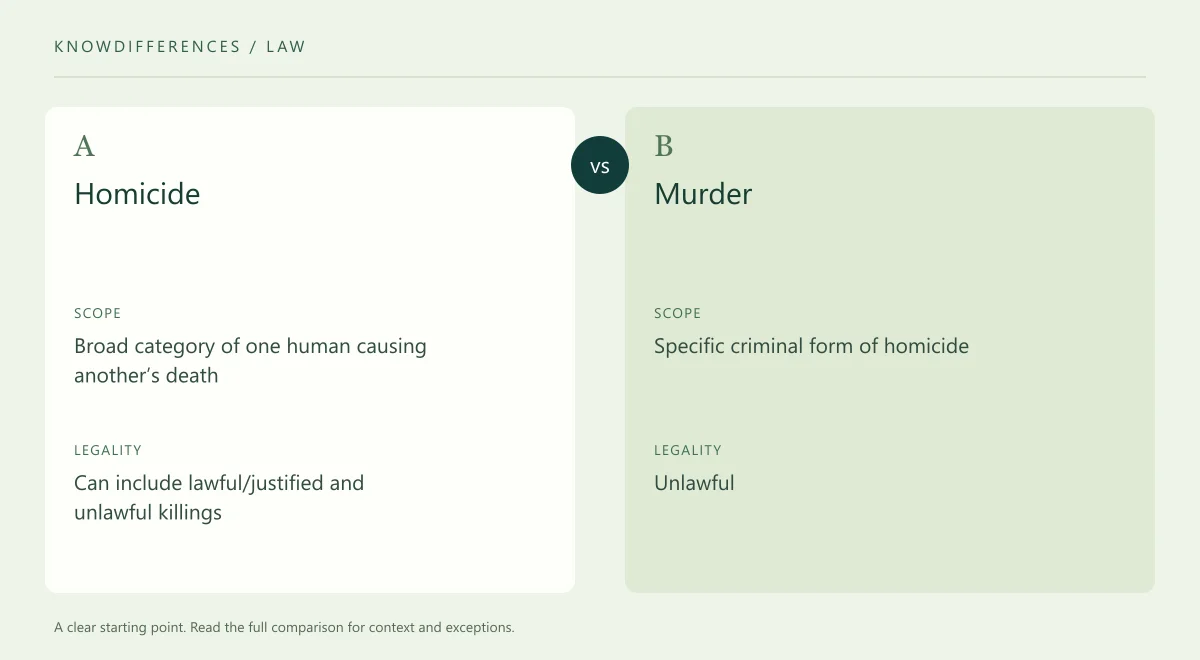
| Scope | Broad category of one human causing another’s death | Specific criminal form of homicide |
| Legality | Can include lawful/justified and unlawful killings | Unlawful |
| Mental state | Varies by type of homicide | Requires the legally defined culpable mental state |
| Examples of related categories | Murder, manslaughter, justified homicide depending jurisdiction | May be divided into degrees or categories |
| Outcome | Not automatically a criminal conviction | Criminal offense if elements are proved |
Similarities
- Both concern the death of a human caused by another human.
- Classification depends on facts, intent and jurisdiction-specific law.
Practical examples
- A death legally ruled justified self-defense may be a homicide without being murder.
- A deliberate unlawful killing satisfying the jurisdiction’s murder elements is both homicide and murder.
How to distinguish them in practice
Use the article to understand the general distinction, then verify the controlling definition and procedure for the relevant jurisdiction before relying on it.
Common mistakes to avoid
- Assuming a legal term has exactly the same definition in every jurisdiction.
- Using everyday speech as if it were the controlling statutory or court definition.
- Inferring a person’s rights or case outcome from a general comparison article.
- Failing to check the current court, statute, regulator or licensed professional for the relevant jurisdiction.
Frequently asked questions
Is every homicide a crime?
No. Some homicides can be legally justified or excused, depending on the law and facts.
Is manslaughter homicide?
Yes, manslaughter is generally a category of criminal homicide distinct from murder.
What makes a homicide murder?
The prosecution must prove the specific elements required by the applicable murder statute or common-law framework.
Are murder degrees universal?
No. Degree systems and definitions vary by jurisdiction.
Bottom line
The most useful first check is scope: Homicide — Broad category of one human causing another’s death; Murder — Specific criminal form of homicide.
Sources and further reading
KnowDifferences Editorial Team
Independent explanations with definitions, practical examples and references. Read our editorial approach.