Important: Legal terminology varies significantly by jurisdiction. This page is general educational information, not legal advice.
What is Lawyer / attorney?
“Lawyer” is a broad term for a legally trained or professionally qualified person. “Attorney,” especially “attorney-at-law” in the United States, commonly refers to a lawyer admitted to practice and represent clients. Terminology and admission rules vary by jurisdiction.
What is Advocate?
“Advocate” can describe the act or role of supporting another person’s interests, but in some legal systems it is also a regulated title for a class of legal professional with rights of audience in courts.
Lawyer / attorney vs Advocate: comparison table
| Point of comparison | Lawyer / attorney | Advocate |
|---|---|---|
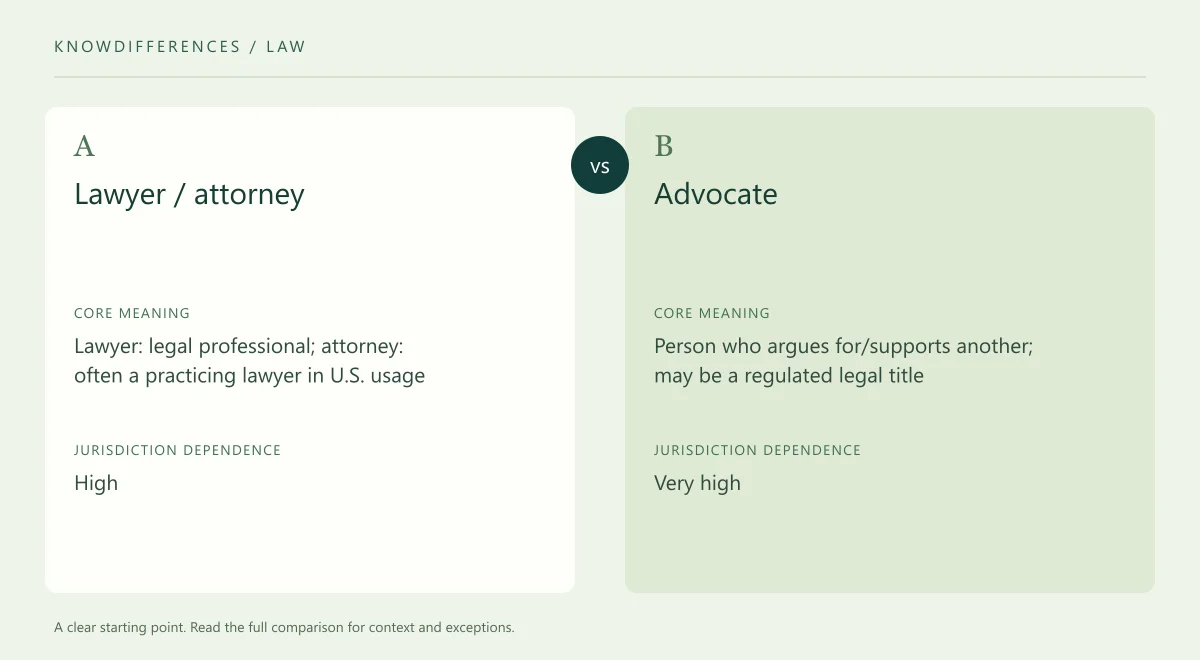
| Core meaning | Lawyer: legal professional; attorney: often a practicing lawyer in U.S. usage | Person who argues for/supports another; may be a regulated legal title |
| Jurisdiction dependence | High | Very high |
| Court representation | Depends on admission and local rules | Depends on whether “advocate” is a formal legal status locally |
| Non-law use | “Lawyer” and “attorney” are usually legal-profession terms | “Advocate” is also used outside law, e.g. patient advocate |
| U.S. everyday usage | Lawyer and attorney are often interchangeable | Usually descriptive, not a separate national license class |
| Other legal systems | Titles may be subdivided into barristers, solicitors, advocates or attorneys | May be a specific professional category |
Similarities
- All three terms can relate to representation, advice or protection of legal interests.
- Professional rights depend on licensing/admission rules, not merely the word someone uses.
Practical examples
- In U.S. everyday speech, “lawyer” and “attorney” often refer to the same practicing legal professional.
- In a country where “advocate” is a protected title, an advocate may have a specific status that cannot be assumed from U.S. usage.
How to distinguish them in practice
Use the article to understand the general distinction, then verify the controlling definition and procedure for the relevant jurisdiction before relying on it.
Common mistakes to avoid
- Assuming a legal term has exactly the same definition in every jurisdiction.
- Using everyday speech as if it were the controlling statutory or court definition.
- Inferring a person’s rights or case outcome from a general comparison article.
- Failing to check the current court, statute, regulator or licensed professional for the relevant jurisdiction.
Frequently asked questions
Are lawyer and attorney exactly the same?
Often in ordinary U.S. usage, yes, but legal terminology varies and “lawyer” can be used more broadly.
Is an advocate always a lawyer?
No. “Advocate” can be a general non-legal role. In some jurisdictions it is also a formal legal title.
Can anyone represent another person in court?
Not necessarily. Courts and jurisdictions impose rules on who may appear or act for another person.
Which term should I use?
Use the title recognized by the relevant jurisdiction and verify professional status with the appropriate bar, law society or regulator.
Bottom line
The most useful first check is core meaning: Lawyer / attorney — Lawyer: legal professional; attorney: often a practicing lawyer in U.S. usage; Advocate — Person who argues for/supports another; may be a regulated legal title.
Sources and further reading
KnowDifferences Editorial Team
Independent explanations with definitions, practical examples and references. Read our editorial approach.