Important: Legal definitions vary significantly. Use the statute and case law of the relevant jurisdiction; this page is not legal advice.
What is Assault?
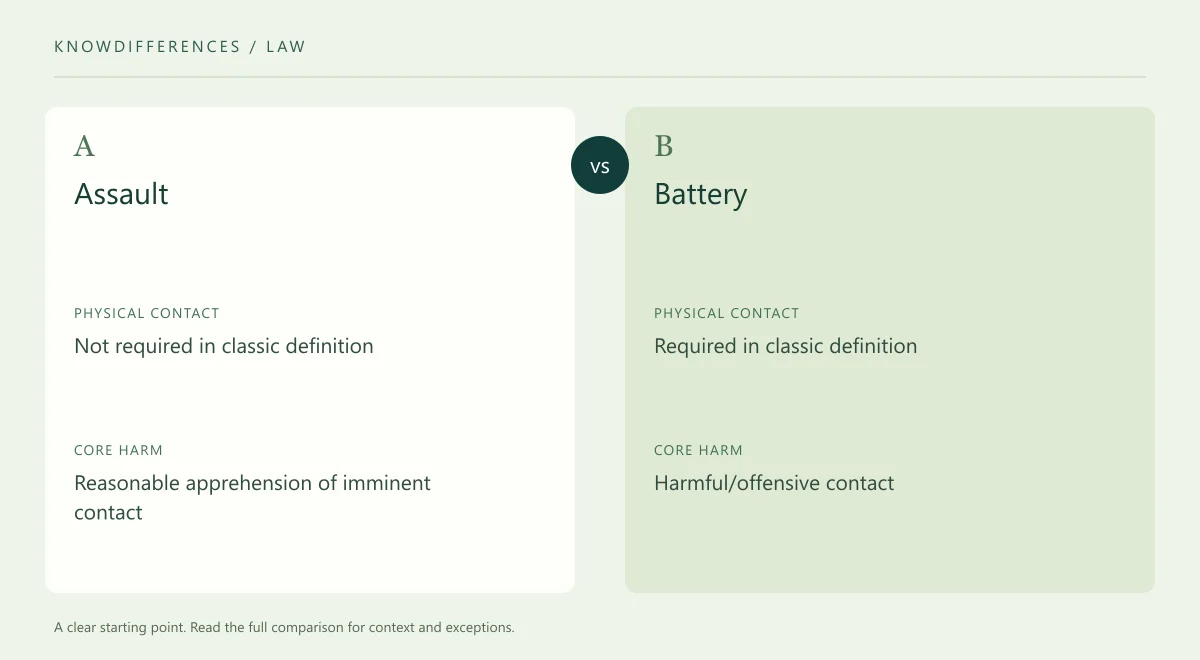
In the classic common-law distinction, assault concerns apprehension of imminent harmful or offensive contact and does not necessarily require physical touching.
What is Battery?
In the classic distinction, battery is the intentional harmful or offensive physical contact itself. Statutes may use different definitions or include battery conduct within an offense called assault.
Assault vs Battery: comparison table
| Point of comparison | Assault | Battery |
|---|---|---|
| Physical contact | Not required in classic definition | Required in classic definition |
| Core harm | Reasonable apprehension of imminent contact | Harmful/offensive contact |
| Completion | Can be complete before touching occurs | Occurs when qualifying contact occurs |
| Modern statutes | May be broader or differently defined | May be merged into assault statutes |
| Civil vs criminal | Can exist as tort and criminal concept | Can exist as tort and criminal concept |
Similarities
- Both protect personal security and bodily autonomy.
- Intent and defenses depend on the applicable legal framework.
- The same event may produce both criminal charges and civil claims.
Practical examples
- Raising a fist and intentionally causing a person to expect an immediate punch may fit classic assault even if no punch lands.
- Actually striking the person may constitute battery under the classic distinction.
How to distinguish them in practice
Use the article to understand the general distinction, then verify the controlling definition and procedure for the relevant jurisdiction before relying on it.
Common mistakes to avoid
- Assuming a legal term has exactly the same definition in every jurisdiction.
- Using everyday speech as if it were the controlling statutory or court definition.
- Inferring a person’s rights or case outcome from a general comparison article.
- Failing to check the current court, statute, regulator or licensed professional for the relevant jurisdiction.
Frequently asked questions
Can there be assault without battery?
Under the classic distinction, yes.
Can there be battery without assault?
Potentially, such as harmful contact the victim did not anticipate, depending on the legal framework.
Why do some states call hitting someone “assault”?
Many statutes changed or merged the common-law labels.
Does consent matter?
Consent can matter in some contexts, but its scope and legal effect depend on the facts and law.
Bottom line
The most useful first check is physical contact: Assault — Not required in classic definition; Battery — Required in classic definition.
Sources and further reading
KnowDifferences Editorial Team
Independent explanations with definitions, practical examples and references. Read our editorial approach.