Important: General U.S.-oriented educational explanation. Pretrial-release law is jurisdiction-specific; consult the relevant court or licensed attorney.
What is Bail?
Bail is the legal arrangement governing pretrial release, which can include a monetary amount and/or conditions imposed by a court. Some jurisdictions use non-monetary release or have restricted commercial bail practices.
What is Bond?
A bond is a promise or financial guarantee associated with release. Depending on local law, it may be a cash bond, property bond, personal recognizance arrangement, or surety bond involving a third party.
Bail vs Bond: comparison table
| Point of comparison | Bail | Bond |
|---|---|---|
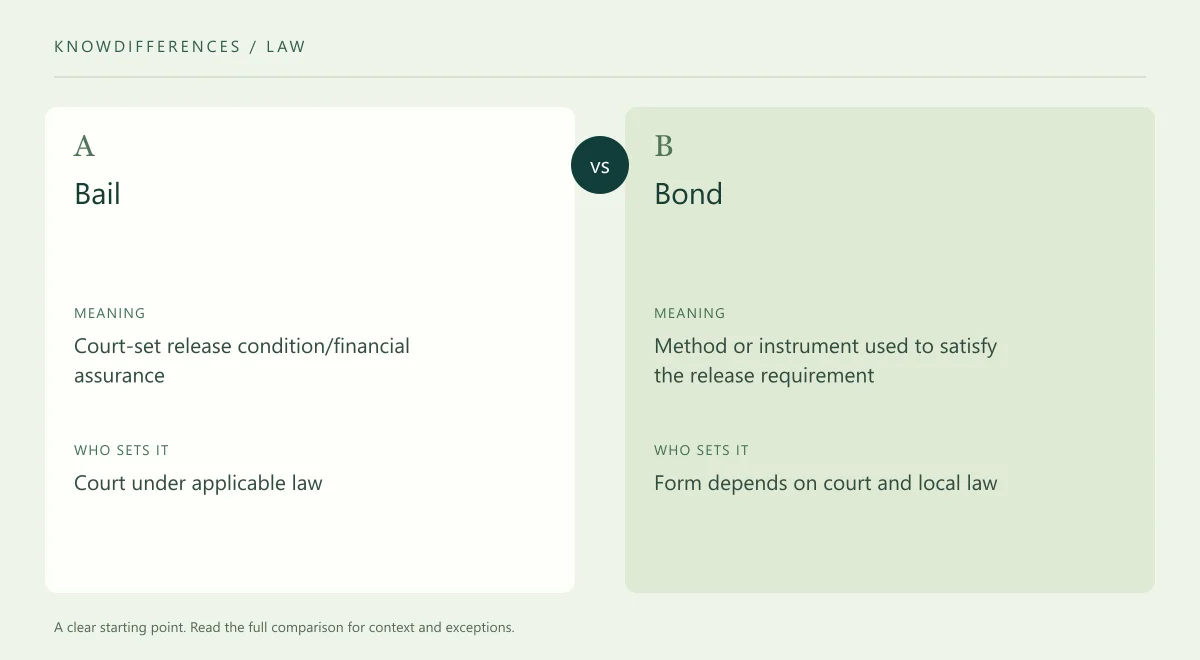
| Meaning | Court-set release condition/financial assurance | Method or instrument used to satisfy the release requirement |
| Who sets it | Court under applicable law | Form depends on court and local law |
| Third party | Not necessarily | Surety bonds may involve a third party |
| Money returned | Depends on the bail form, compliance and fees | Cash/property treatment differs from nonrefundable commercial surety fees |
| Availability | Jurisdiction-specific | Commercial bail bonds prohibited or limited in some places |
Similarities
- Both relate to pretrial release and appearance in court.
- Rules differ substantially by jurisdiction and case type.
Practical examples
- A judge may set a $10,000 bail condition; the permitted way to satisfy it could be a cash deposit or a surety bond, depending on local rules.
How to distinguish them in practice
Use the article to understand the general distinction, then verify the controlling definition and procedure for the relevant jurisdiction before relying on it.
Common mistakes to avoid
- Assuming a legal term has exactly the same definition in every jurisdiction.
- Using everyday speech as if it were the controlling statutory or court definition.
- Inferring a person’s rights or case outcome from a general comparison article.
- Failing to check the current court, statute, regulator or licensed professional for the relevant jurisdiction.
Frequently asked questions
Are bail and bond interchangeable?
People often use them interchangeably, but technically bail is the release framework/amount while a bond is one method of securing it.
Do you always get bail money back?
Not necessarily. Treatment depends on the type of payment, compliance, court costs and local rules; commercial surety fees are often nonrefundable.
Can a judge deny release?
In some circumstances and jurisdictions, yes.
Are bail bond companies legal everywhere?
No. Commercial bail-bond systems are restricted or prohibited in some jurisdictions.
Bottom line
The most useful first check is meaning: Bail — Court-set release condition/financial assurance; Bond — Method or instrument used to satisfy the release requirement.
Sources and further reading
KnowDifferences Editorial Team
Independent explanations with definitions, practical examples and references. Read our editorial approach.