What is Businessperson?
A businessperson owns, manages or participates in commercial activity. The business may use an established model, serve an existing local market and prioritize steady operations, cash flow and profitability.
What is Entrepreneur?
An entrepreneur identifies an opportunity and organizes resources to create or expand a venture under uncertainty. Innovation may involve a product, process, distribution model, customer segment or business model rather than a wholly new invention.
Businessperson vs Entrepreneur: comparison table
| Point of comparison | Businessperson | Entrepreneur |
|---|---|---|
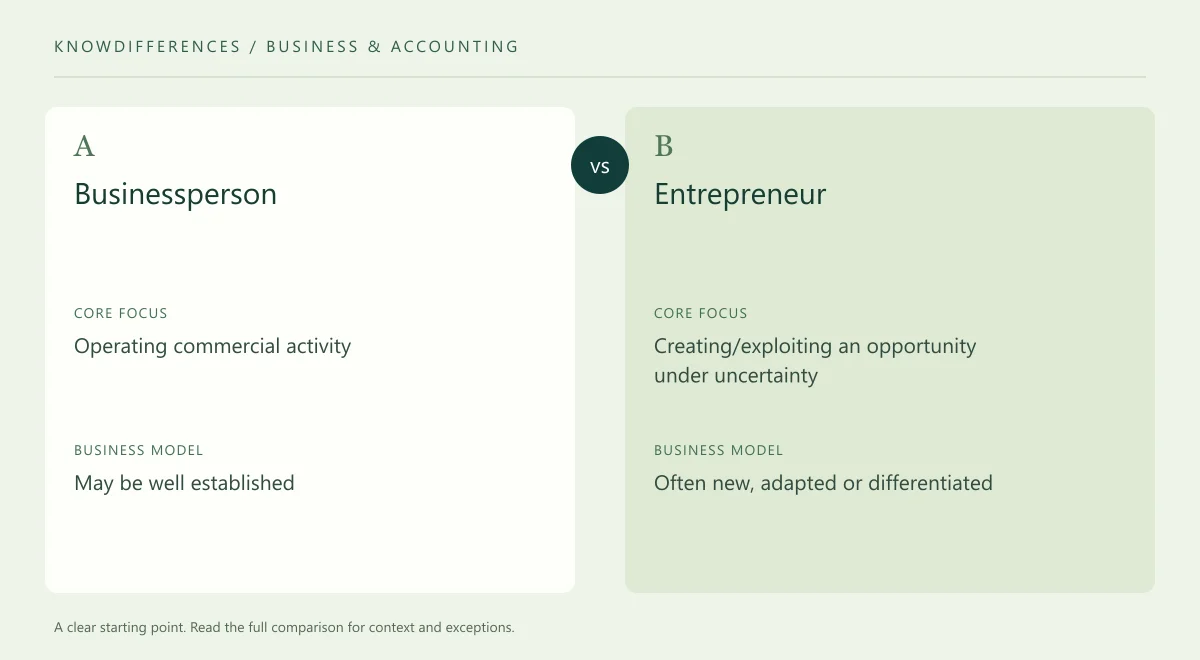
| Core focus | Operating commercial activity | Creating/exploiting an opportunity under uncertainty |
| Business model | May be well established | Often new, adapted or differentiated |
| Risk | Normal commercial risk | Often higher uncertainty during creation/growth |
| Innovation | Not required | Common but can be incremental |
| Growth goal | Can prioritize stable local profit | Often seeks scalable growth, though not always |
| Resource role | Runs existing resources/processes | Combines resources around an opportunity |
| Example | Owner of a mature local retail store | Founder testing a new logistics marketplace |
Other practical distinctions
- Example: Businessperson: Owner of a mature local retail store. Entrepreneur: Founder testing a new logistics marketplace.
Similarities
- Both must understand customers, costs, cash flow and competition.
- Both can employ staff, raise capital and build long-term organizations.
- A person can shift between the roles over time.
Practical examples
- Buying and efficiently operating an established franchise is clearly business activity and can also involve entrepreneurship if the owner develops new processes or markets.
- Launching a new product category with an unproven market is a classic entrepreneurial situation.
How to distinguish them in practice
Identify whether the question is about operational records, valuation, reporting or economic analysis; the correct term follows from that context.
Common mistakes to avoid
- Using everyday meanings where accounting or economics assigns a more specific definition.
- Mixing quantity records, valuation records and financial-reporting concepts.
- Comparing figures prepared under different assumptions or time periods.
- Using the comparison as a substitute for the entity’s accounting policy or applicable reporting rules.
Frequently asked questions
Is every entrepreneur a businessperson?
In practical usage, an entrepreneur running a commercial venture is also a businessperson.
Does entrepreneurship require inventing technology?
No. Entrepreneurship can involve new services, distribution, organization or market positioning.
Can a small local business owner be an entrepreneur?
Yes, especially when they create a new opportunity or innovative model. Size alone does not define entrepreneurship.
Which is better?
Neither label is inherently better. A stable, well-run established business can be as valuable as a high-growth entrepreneurial venture.
Bottom line
The most useful first check is core focus: Businessperson — Operating commercial activity; Entrepreneur — Creating/exploiting an opportunity under uncertainty.
Sources and further reading
KnowDifferences Editorial Team
Independent explanations with definitions, practical examples and references. Read our editorial approach.