What is Soccer cleats?
Soccer footwear is designed to provide traction while allowing repeated running, cutting and close contact with the ball. Stud patterns vary for firm ground, artificial ground and soft ground.
What is Softball cleats?
Softball cleats are designed for traction on dirt and grass during batting, fielding and base running. Depending on age group and league, molded or metal cleats may be allowed.
Soccer cleats vs Softball cleats: comparison table
| Point of comparison | Soccer cleats | Softball cleats |
|---|---|---|
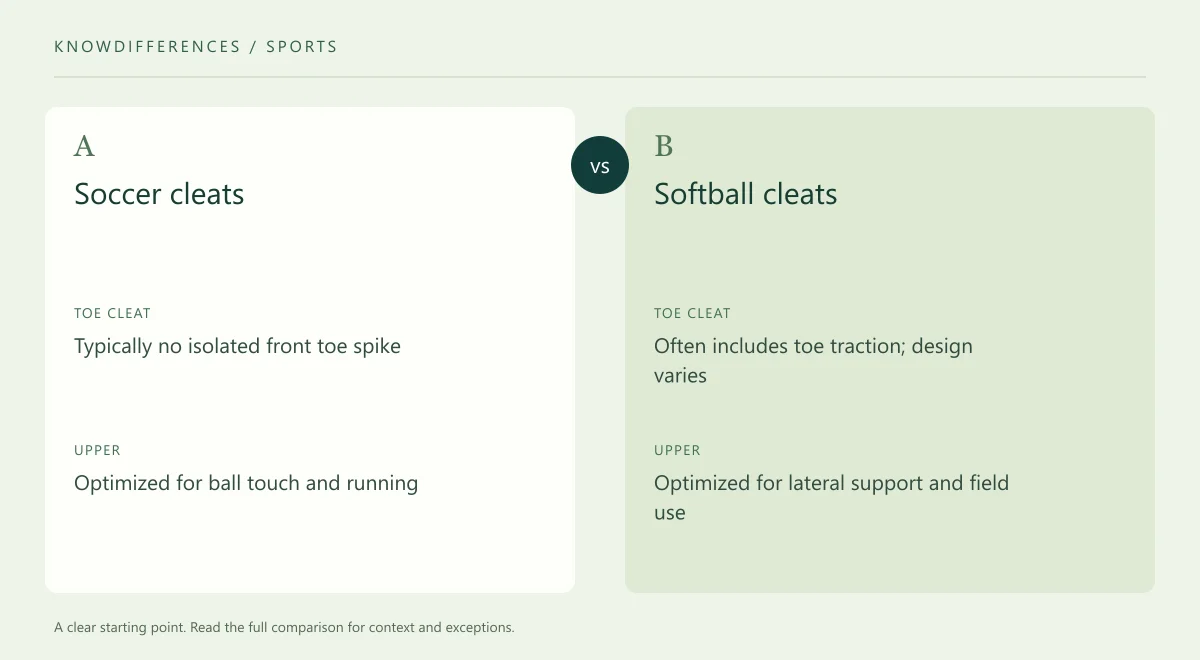
| Toe cleat | Typically no isolated front toe spike | Often includes toe traction; design varies |
| Upper | Optimized for ball touch and running | Optimized for lateral support and field use |
| Stud/spike layout | Distributed for multidirectional movement | Configured for dirt/grass acceleration and base running |
| Metal options | Soft-ground replaceable studs exist, but soccer rules/equipment differ | Metal softball cleats may be permitted in some leagues/ages |
| Cross-use | Baseball/softball cleat designs may be illegal/unsafe for soccer | Soccer cleats may be usable in some softball contexts but may not provide ideal traction |
| Fit priority | Low bulk, close ball feel | Traction, stability and lateral support |
Similarities
- Both need secure fit and sport-appropriate traction.
- Both come in molded synthetic options.
- Field surface and governing-body rules matter.
Practical examples
- A prominent front toe spike that helps push off on dirt is a red flag for soccer use because soccer footwear rules and contact considerations differ.
How to distinguish them in practice
Check the playing surface, governing rules, fit and manufacturer specification together; visual similarity alone is not enough.
Common mistakes to avoid
- Choosing equipment by appearance rather than surface, sport rules, fit and manufacturer design.
- Assuming a cleat pattern permitted by one league is automatically legal in another.
- Ignoring comfort and fit because two products have similar names.
- Using modified footwear or hardware without checking the governing rules and field requirements.
Frequently asked questions
Can I wear softball cleats for soccer?
Usually not recommended; certain toe-spike configurations can be prohibited and the footwear is not optimized for soccer.
Can soccer cleats be used for softball?
Sometimes, especially recreationally, if league rules permit, but traction may be less specialized for dirt/base running.
Are metal cleats allowed?
Rules depend on sport, age and league. Check the current rulebook.
What matters most when buying?
Correct size, heel lockdown, surface-compatible traction and compliance with league rules.
Bottom line
The most useful first check is toe cleat: Soccer cleats — Typically no isolated front toe spike; Softball cleats — Often includes toe traction; design varies.
Sources and further reading
KnowDifferences Editorial Team
Independent explanations with definitions, practical examples and references. Read our editorial approach.