What is Baseball cleats?
Baseball cleats use traction patterns suited to dirt, grass, sprinting out of the batter’s box and abrupt fielding movements. Molded and, where permitted, metal spike models are common.
What is Soccer cleats?
Soccer cleats are shaped for repeated running and kicking, with stud patterns that support traction without interfering with ball contact and player-to-player safety.
Baseball cleats vs Soccer cleats: comparison table
| Point of comparison | Baseball cleats | Soccer cleats |
|---|---|---|
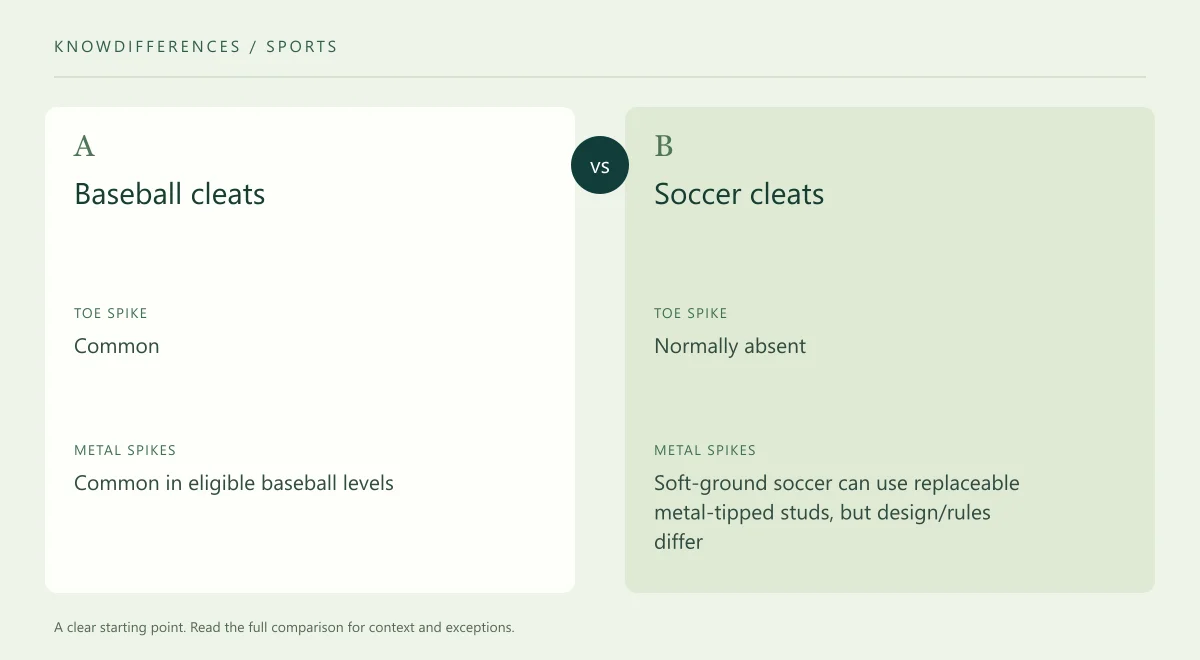
| Toe spike | Common | Normally absent |
| Metal spikes | Common in eligible baseball levels | Soft-ground soccer can use replaceable metal-tipped studs, but design/rules differ |
| Upper design | Fielding/base-running support | Close ball feel and running |
| Midsole | Can have more cushioning/support | Often lower-profile for field feel |
| Surface | Dirt/grass baseball diamonds | Grass or artificial soccer surfaces |
| Cross-use | Generally unsuitable for soccer if toe spike present | May be acceptable for some baseball use but not ideal |
Similarities
- Both need fit, traction and sport-rule compliance.
- Both are available in molded synthetic styles.
Practical examples
- A front spike beneath the toe can help a baseball player push off but is one of the key reasons baseball cleats should not be substituted for soccer boots.
How to distinguish them in practice
Check the playing surface, governing rules, fit and manufacturer specification together; visual similarity alone is not enough.
Common mistakes to avoid
- Choosing equipment by appearance rather than surface, sport rules, fit and manufacturer design.
- Assuming a cleat pattern permitted by one league is automatically legal in another.
- Ignoring comfort and fit because two products have similar names.
- Using modified footwear or hardware without checking the governing rules and field requirements.
Why the toe cleat matters
Baseball players accelerate out of a batter’s box, push off dirt and need traction during base running. A toe cleat can help those movements. In soccer, feet regularly come close to other players during tackles, so a forward protruding stud can be hazardous.
Referees can reject footwear they consider dangerous even when a rulebook does not name every possible outsole pattern.
Metal cleats
Youth baseball leagues often restrict metal cleats by age. Soccer rules and competition regulations also govern stud safety; some environments permit replaceable metal-tipped studs while others do not.
Never assume “metal is allowed because professionals use it.” Check the exact competition rules.
Can soccer cleats work for baseball?
For some recreational/youth players, soccer cleats provide acceptable grass traction and are often safer as a cross-sport option than using baseball cleats for soccer. They may offer less bite in dirt and lack baseball-specific support.
Performance and legality are separate questions, so check the league before buying one pair for both sports.
Frequently asked questions
Why do baseball cleats have a toe spike?
It can improve push-off traction for batting, throwing and base running.
Can baseball cleats be worn in soccer?
Generally no, especially when they include a front toe spike or other non-compliant design.
Can soccer cleats be used in baseball?
Sometimes under league rules, but they may provide less dirt-specific traction.
Are metal cleats allowed for youth players?
Rules vary by league and age. Check the current competition rules.
Bottom line
The most useful first check is toe spike: Baseball cleats — Common; Soccer cleats — Normally absent.
Sources and further reading
KnowDifferences Editorial Team
Independent explanations with definitions, practical examples and references. Read our editorial approach.