What is Soccer cleats?
Soccer cleats are designed for continuous movement and direct contact with the ball. They are commonly low-cut with stud layouts suited to firm ground, artificial ground or soft ground.
What is American-football cleats?
Football cleats are designed for explosive starts, cutting and contact. Models vary by position, with different levels of ankle support and traction geometry.
Soccer cleats vs American-football cleats: comparison table
| Point of comparison | Soccer cleats | American-football cleats |
|---|---|---|
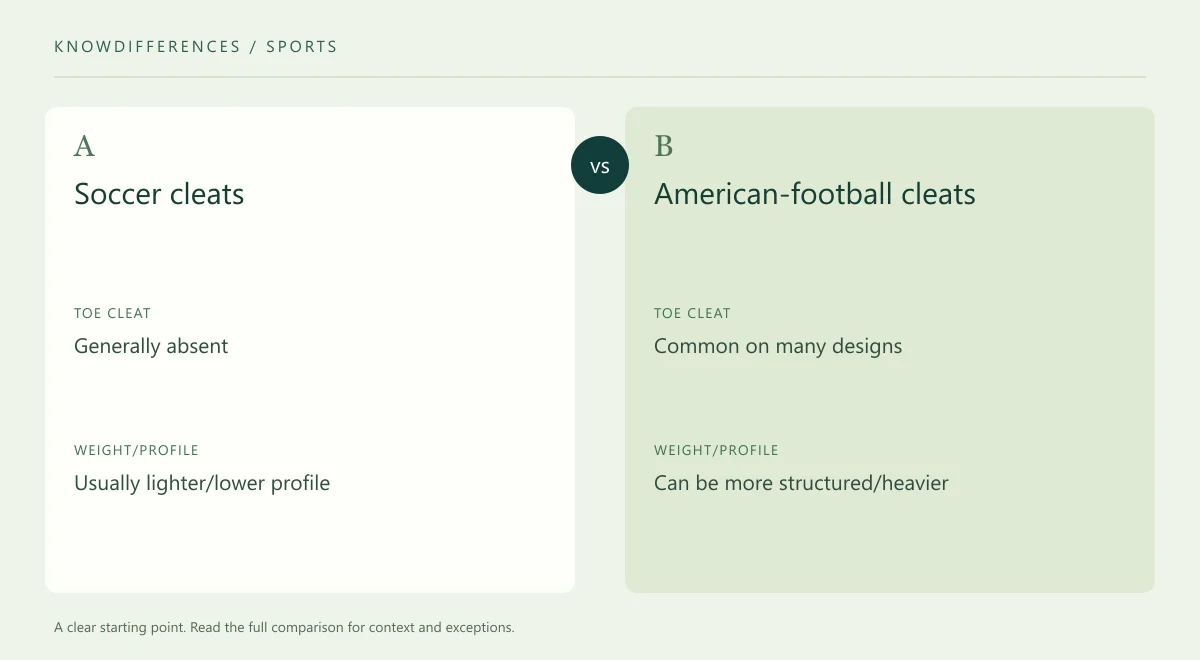
| Toe cleat | Generally absent | Common on many designs |
| Weight/profile | Usually lighter/lower profile | Can be more structured/heavier |
| Ball contact | Upper designed with touch in mind | Ball touch is not primary design goal |
| Position variants | Surface/style variants, less position-specific | Skill/lineman and other position-oriented designs exist |
| Stud layout | Multidirectional soccer traction | Acceleration/contact/cutting-oriented traction |
| Cross-use | Football toe cleat may violate soccer requirements | Soccer cleats can sometimes be used in football if rules and traction needs allow |
Similarities
- Both require a secure fit and compatible playing surface.
- Both use molded or detachable traction systems depending model and rules.
Practical examples
- A soccer winger may prefer a lightweight low-cut boot, while a football lineman may prioritize stability and a more supportive upper.
How to distinguish them in practice
Check the playing surface, governing rules, fit and manufacturer specification together; visual similarity alone is not enough.
Common mistakes to avoid
- Choosing equipment by appearance rather than surface, sport rules, fit and manufacturer design.
- Assuming a cleat pattern permitted by one league is automatically legal in another.
- Ignoring comfort and fit because two products have similar names.
- Using modified footwear or hardware without checking the governing rules and field requirements.
Why soccer outsoles are different
Soccer players tackle, slide and make frequent foot-to-ball contact. Stud shape and projection must provide traction without creating unnecessary danger to other players.
Football positions change footwear needs
A lineman may prioritize lateral support and traction under heavy contact, while a receiver may prioritize speed and cutting. Football footwear therefore spans a wider range of upper heights and support structures.
Surface still matters
Firm natural grass, soft ground, artificial grass and hard turf need different traction. Wearing long aggressive studs on an unsuitable artificial surface can increase discomfort or injury risk.
Frequently asked questions
Can football cleats be used for soccer?
Usually not recommended; front toe-cleat design can be incompatible with soccer rules and safety expectations.
Can soccer cleats be used for football?
Sometimes, especially for kickers or skill players, if league rules allow and traction is adequate.
Are high-top cleats required for football?
No. Cut height varies by model and player preference.
Which surface label matters?
Use the manufacturer’s designation for firm ground, artificial ground, turf or soft ground as appropriate.
Bottom line
The most useful first check is toe cleat: Soccer cleats — Generally absent; American-football cleats — Common on many designs.
Sources and further reading
KnowDifferences Editorial Team
Independent explanations with definitions, practical examples and references. Read our editorial approach.