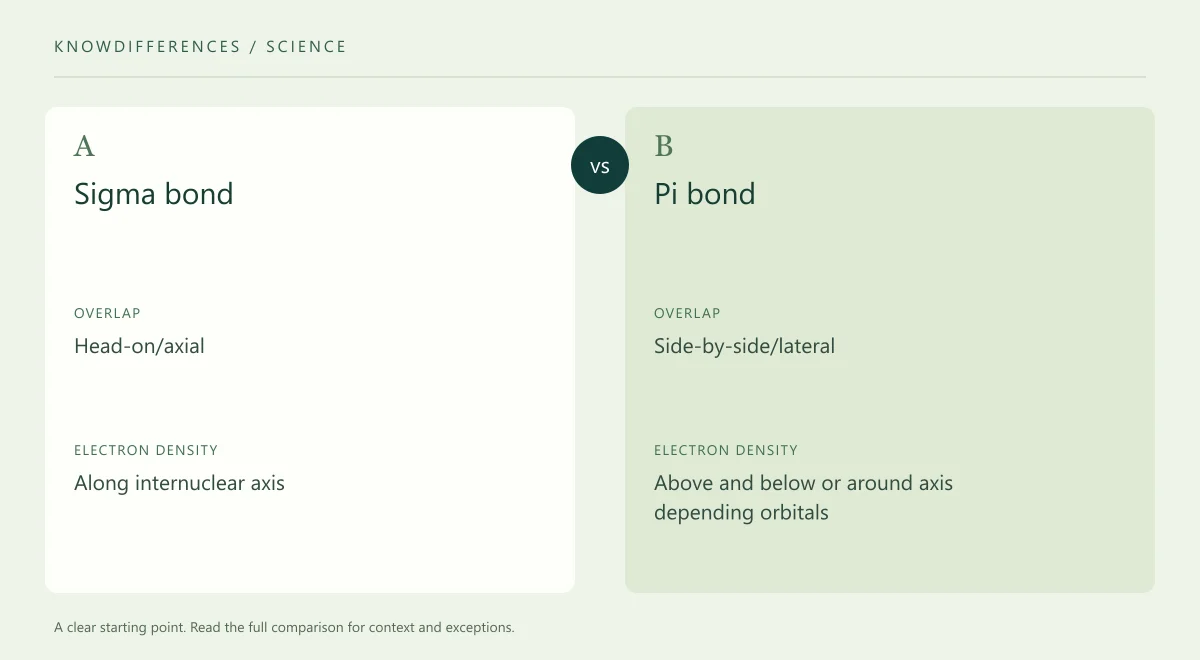
What is Sigma bond?
A sigma bond has electron density concentrated along the line connecting the bonded nuclei. It can arise from overlap of s orbitals, p orbitals, hybrid orbitals or combinations of these.
What is Pi bond?
A pi bond arises from lateral overlap of parallel orbitals, most commonly unhybridized p orbitals, producing electron density on opposite sides of the internuclear axis.
Sigma bond vs Pi bond: comparison table
| Point of comparison | Sigma bond | Pi bond |
|---|---|---|
| Overlap | Head-on/axial | Side-by-side/lateral |
| Electron density | Along internuclear axis | Above and below or around axis depending orbitals |
| Presence in single bond | Yes | No |
| Multiple bonds | One sigma forms the first bond | Additional bond(s) in double/triple bond |
| Rotation | Sigma framework often permits rotation if no other constraint | Pi overlap restricts free rotation |
| Typical overlap strength | Often stronger for comparable orbitals because overlap is more direct | Often weaker than corresponding sigma overlap |
Similarities
- Both are covalent bonding interactions involving orbital overlap and shared electron density.
- Both contribute to molecular stability and geometry.
Practical examples
- Ethane’s C–C single bond is a sigma bond.
- Ethene’s C=C double bond contains one sigma and one pi bond.
- A carbon-carbon triple bond contains one sigma and two mutually perpendicular pi bonds.
How to distinguish them in practice
Start with the defining biological, chemical or physical principle, then use the table to connect that principle to observable consequences.
Common mistakes to avoid
- Memorizing a single difference without understanding the underlying structure or process.
- Treating a classroom simplification as a rule with no exceptions.
- Mixing levels of comparison, such as comparing a structure on one side with a process on the other.
- Using an unlabeled diagram or definition without checking standard scientific terminology.
Frequently asked questions
Is every single bond a sigma bond?
In ordinary valence-bond descriptions, yes: a single covalent bond is a sigma bond.
Can a pi bond exist without a sigma bond between the same two atoms?
In standard introductory bonding descriptions, multiple bonding begins with a sigma bond and additional bond order is pi bonding.
Why does a double bond restrict rotation?
Rotating the bonded atoms would disrupt the parallel orbital alignment needed for pi overlap.
Which is stronger?
A sigma interaction from comparable orbitals is generally stronger than a single pi interaction because axial overlap is more effective, though actual bond energies depend on the atoms and molecule.
Bottom line
The most useful first check is overlap: Sigma bond — Head-on/axial; Pi bond — Side-by-side/lateral.
Sources and further reading
KnowDifferences Editorial Team
Independent explanations with definitions, practical examples and references. Read our editorial approach.