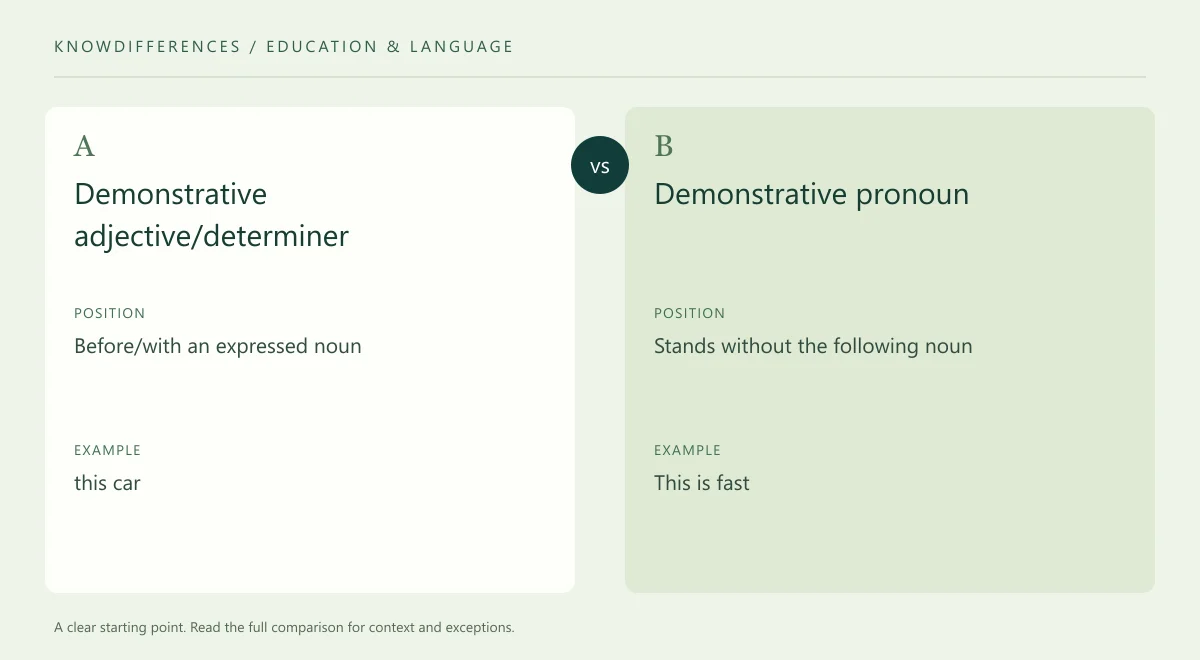
What is Demonstrative adjective/determiner?
A demonstrative used directly with a noun phrase points out which person or thing is meant: this book, that idea, these shoes, those houses. Modern linguistic descriptions usually classify these words as determiners rather than adjectives.
What is Demonstrative pronoun?
A demonstrative pronoun stands as the head of a noun phrase without an expressed following noun: “This is heavy,” “I prefer those,” or “That was unexpected.”
Demonstrative adjective/determiner vs Demonstrative pronoun: comparison table
| Point of comparison | Demonstrative adjective/determiner | Demonstrative pronoun |
|---|---|---|
| Position | Before/with an expressed noun | Stands without the following noun |
| Example | this car | This is fast |
| Plural near | these books | These are mine |
| Plural far | those trees | Those are tall |
| Traditional label | Demonstrative adjective | Demonstrative pronoun |
| Modern label | Demonstrative determiner | Demonstrative pronoun/determinative used pronominally, depending grammar |
Similarities
- Both point to entities, ideas or situations in context.
- Both use the same core forms: this, that, these and those.
- Both encode number; this/that are singular and these/those are plural.
Practical examples
- “Those shoes are wet”: those modifies the noun shoes.
- “Those are wet”: those stands alone as a pronoun-like noun phrase.
How to distinguish them in practice
Look at the function the word, section or document performs in context. Form and placement help, but function is the stronger test.
Common mistakes to avoid
- Looking only at spelling or position instead of the word’s function in the sentence or document.
- Assuming two forms are interchangeable because they discuss the same subject.
- Ignoring style-guide, institutional or assignment requirements.
- Using an example without checking what role each word or section performs.
Frequently asked questions
Is “this” always a pronoun?
No. In “this house,” it accompanies a noun; in “this is my house,” it stands on its own.
Why do some books say determiner instead of adjective?
Modern grammar often treats words such as this and that as determiners because their syntactic behavior differs from descriptive adjectives such as blue or large.
Can demonstratives refer to ideas, not just objects?
Yes. “That was surprising” can refer to an entire event or statement.
What are the four English demonstratives?
This, that, these and those.
Bottom line
The most useful first check is position: Demonstrative adjective/determiner — Before/with an expressed noun; Demonstrative pronoun — Stands without the following noun.
Sources and further reading
KnowDifferences Editorial Team
Independent explanations with definitions, practical examples and references. Read our editorial approach.