What is Biography?
A biography is a nonfiction narrative about a person’s life written by another author. A biographer may use interviews, letters, archives, public records and other sources to reconstruct events and context.
What is Autobiography?
An autobiography is a nonfiction account in which the subject writes about their own life. It usually uses first-person perspective and relies strongly on the author’s memories, records and interpretation of personal experience.
Biography vs Autobiography: comparison table
| Point of comparison | Biography | Autobiography |
|---|---|---|
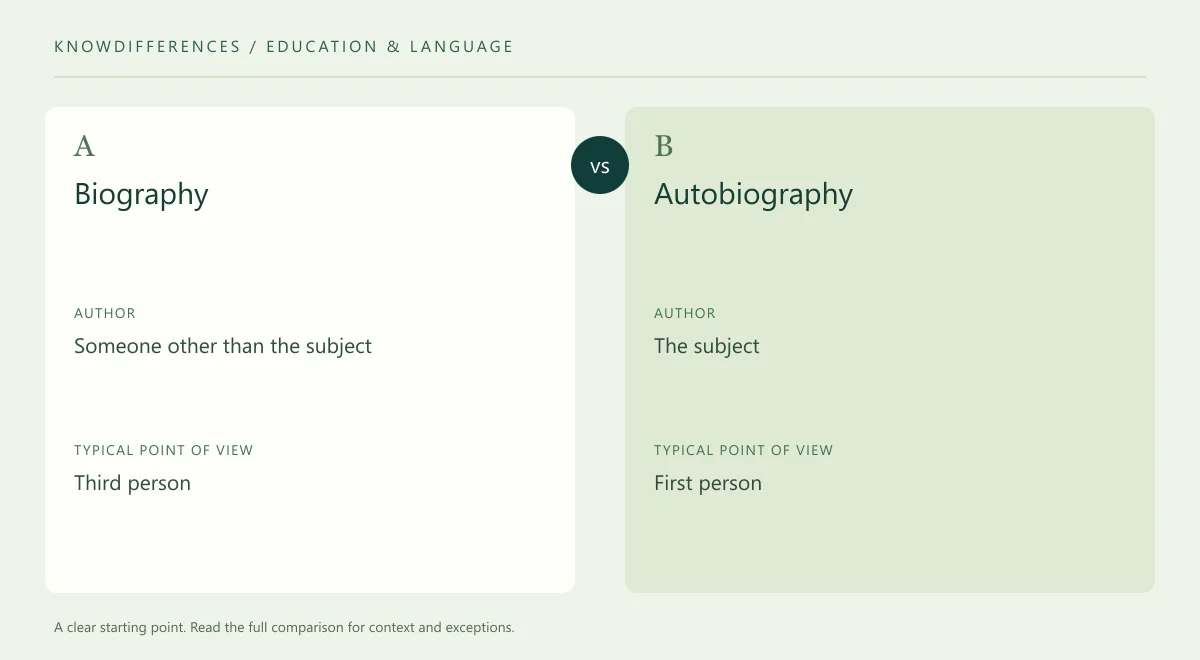
| Author | Someone other than the subject | The subject |
| Typical point of view | Third person | First person |
| Access to inner experience | Inferred from sources/interviews unless documented | Directly described by the subject |
| Perspective | External interpretation | Personal retrospective interpretation |
| Source base | May draw widely on independent evidence | Often centered on memory and personal records |
| Bias risk | Biographer selection and interpretation | Self-presentation, memory and hindsight |
| Authorization | Can be authorized or unauthorized | By definition written by the subject |
| Example form | Life of a historical figure by a historian | Public figure recounting their own life |
Other practical distinctions
- Authorization: Biography: Can be authorized or unauthorized. Autobiography: By definition written by the subject.
- Example form: Biography: Life of a historical figure by a historian. Autobiography: Public figure recounting their own life.
Similarities
- Both are nonfiction life-writing forms.
- Both select events rather than documenting every moment of a life.
- Both may include historical context, relationships, achievements and failures.
- Both should distinguish verifiable fact from interpretation.
Practical examples
- A historian writing the life of Marie Curie is producing a biography.
- A scientist writing a book about their own childhood, career and discoveries is producing an autobiography.
How to distinguish them in practice
Look at the function the word, section or document performs in context. Form and placement help, but function is the stronger test.
Common mistakes to avoid
- Looking only at spelling or position instead of the word’s function in the sentence or document.
- Assuming two forms are interchangeable because they discuss the same subject.
- Ignoring style-guide, institutional or assignment requirements.
- Using an example without checking what role each word or section performs.
Frequently asked questions
Is a memoir the same as an autobiography?
Not exactly. A memoir usually concentrates on selected experiences or themes, while an autobiography often attempts a broader chronological life account.
Can a biography be unauthorized?
Yes. A biographer can write from lawful public and private sources without the subject’s authorization, subject to applicable law.
Are autobiographies always accurate?
They are valuable first-person sources but memory, perspective and self-presentation can affect accuracy.
What point of view does an autobiography use?
Usually first person: I, me, my and we.
Bottom line
The most useful first check is author: Biography — Someone other than the subject; Autobiography — The subject.
Sources and further reading
KnowDifferences Editorial Team
Independent explanations with definitions, practical examples and references. Read our editorial approach.