What is Abstract?
An abstract is a stand-alone summary placed near the beginning of a research paper, thesis or report. Its exact structure depends on the field and publication, but it often reports the question, methods, principal findings and conclusion in a limited word count.
What is Introduction?
The introduction is the opening section of the main text. It establishes context, explains why the topic matters, identifies the problem or gap and states the aims, hypotheses or research questions.
Abstract vs Introduction: comparison table
| Point of comparison | Abstract | Introduction |
|---|---|---|
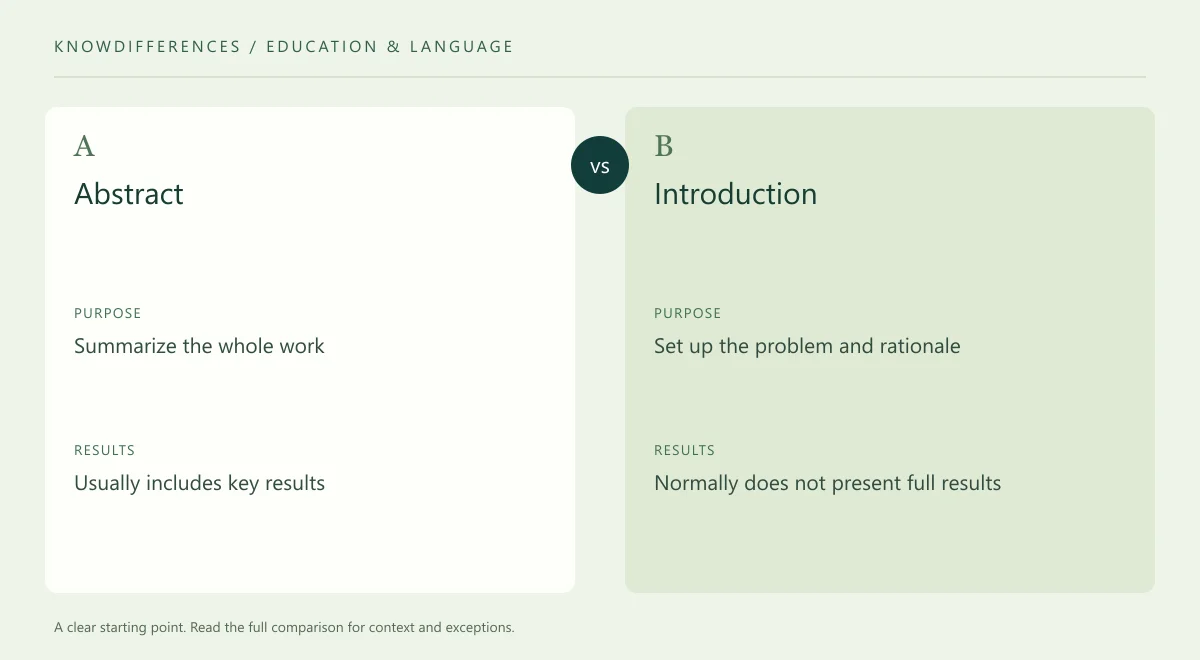
| Purpose | Summarize the whole work | Set up the problem and rationale |
| Results | Usually includes key results | Normally does not present full results |
| Methods | Often summarizes methods briefly | May mention approach but not full method detail |
| Length | Short, often constrained | Longer and integrated with main paper |
| Can stand alone | Designed to be informative alone | Depends on rest of paper |
| Placement | Before main text | First main section |
Similarities
- Both orient the reader to the paper’s subject and objective.
- Both should use terminology consistent with the main text.
- Both are usually written or refined after the research is well defined.
Practical examples
- An abstract may state that a randomized study of 200 participants found a measured effect.
- The introduction would explain the prior evidence, unresolved question and hypothesis that motivated the study.
How to distinguish them in practice
Look at the function the word, section or document performs in context. Form and placement help, but function is the stronger test.
Common mistakes to avoid
- Looking only at spelling or position instead of the word’s function in the sentence or document.
- Assuming two forms are interchangeable because they discuss the same subject.
- Ignoring style-guide, institutional or assignment requirements.
- Using an example without checking what role each word or section performs.
Frequently asked questions
Should an abstract contain citations?
Many journals discourage or prohibit citations in abstracts unless necessary; follow the target publication’s rules.
Does the introduction reveal the conclusion?
It normally frames the research question rather than giving a full result summary, although conventions vary.
Which should I write first?
Many authors draft the introduction earlier but write or finalize the abstract last, after results and conclusions are settled.
Is an executive summary the same as an abstract?
No. Executive summaries are common in business/policy reports and can include recommendations and more detail than a scholarly abstract.
Bottom line
The most useful first check is purpose: Abstract — Summarize the whole work; Introduction — Set up the problem and rationale.
Sources and further reading
KnowDifferences Editorial Team
Independent explanations with definitions, practical examples and references. Read our editorial approach.