What is a bin card?
A bin card is a stock record maintained for an individual material or inventory item, traditionally kept at or near the bin, rack or storage location. Its main purpose is to show physical receipts, issues and the resulting quantity on hand.
What is a stores ledger?
A store ledger is an inventory accounting record maintained by stores/accounts personnel. It commonly records receipts, issues and balances in both quantity and monetary value, using the organization’s chosen inventory valuation method.
Bin card vs Store ledger: comparison table
| Point of comparison | Bin card | Store ledger |
|---|---|---|
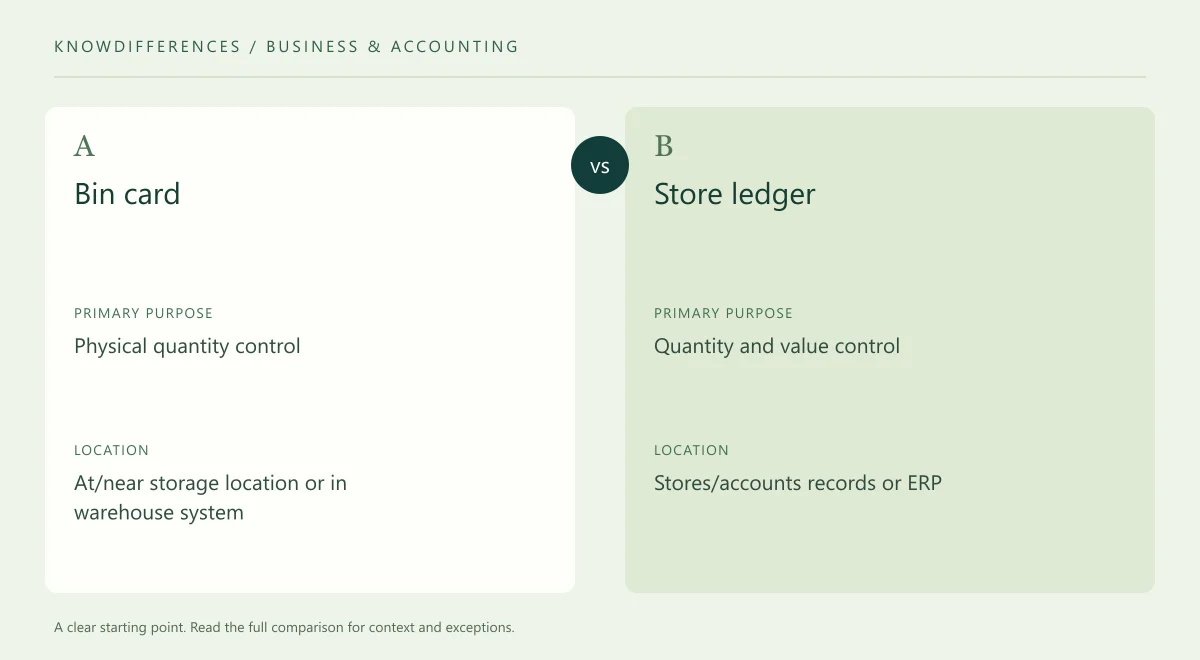
| Primary purpose | Physical quantity control | Quantity and value control |
| Location | At/near storage location or in warehouse system | Stores/accounts records or ERP |
| Values recorded | Usually quantities only | Quantities and monetary values |
| Typical custodian | Storekeeper or warehouse staff | Stores accountant/costing/accounts staff |
| Update trigger | Every receipt and issue | Every receipt and issue, including valuation |
| Use in costing | Limited | Directly supports inventory valuation and cost records |
| Stock verification | Helps compare book quantity with physical stock | Helps reconcile quantity and value records |
| Complexity | Simple operational record | More detailed accounting record |
Quantity control and value control
A bin card helps the storekeeper follow how many units entered a storage location, how many left and how many should remain. A stores ledger adds the monetary side of those movements. Both records should identify the same material and use matching document references so a receipt or issue can be traced.
The traditional distinction is between a quantity record maintained in the store and a quantity-and-value record used in cost accounting. In software, those functions may be views of the same underlying transactions rather than two separately typed paper records.
Worked example: one batch at a single unit cost
Assume a storeroom starts with no stock, receives 100 identical items at 5 currency units each, then issues 30 items. There are no additional costs, losses, returns or price changes in this example.
| Movement | Received | Issued | Quantity remaining | Value remaining |
|---|---|---|---|---|
| Opening balance | 0 | 0 | 0 | 0 |
| Receipt | 100 | 0 | 100 | 500 |
| Issue | 0 | 30 | 70 | 350 |
The quantity record shows 70 items remaining. The stores ledger also shows a remaining value of 350 and an issue value of 150. With several purchase prices, the valuation method matters; this deliberately simple example isolates the difference between counting units and recording their value.
If the balances disagree
Compare the item code, unit of measure, transaction dates and supporting receipt/issue documents before changing a balance. A missing entry or different unit of measure can create a mismatch even when the physical stock has not moved unexpectedly. Record any approved correction so the reconciliation remains traceable.
Other practical distinctions
- Stock verification: Bin card: Helps compare book quantity with physical stock. Store ledger: Helps reconcile quantity and value records.
- Complexity: Bin card: Simple operational record. Store ledger: More detailed accounting record.
Similarities
- Both are maintained item by item.
- Both should record receipts, issues and balances promptly.
- Both support inventory control and reconciliation.
- Modern ERP systems may represent both concepts digitally rather than as separate paper records.
Practical examples
- If 100 units are received and 30 are issued, a bin card may simply show a balance of 70 units.
- A store ledger may show the same 70 units plus their unit cost and total value, subject to the entity’s valuation method.
How to distinguish them in practice
Identify whether the question is about operational records, valuation, reporting or economic analysis; the correct term follows from that context.
Common mistakes to avoid
- Using everyday meanings where accounting or economics assigns a more specific definition.
- Mixing quantity records, valuation records and financial-reporting concepts.
- Comparing figures prepared under different assumptions or time periods.
- Using the comparison as a substitute for the entity’s accounting policy or applicable reporting rules.
Frequently asked questions
Is a bin card an accounting record?
It is primarily a stores/quantity control record, although it supports accounting by providing movement and balance information.
Can software replace bin cards?
Yes. Warehouse and ERP systems can provide the same quantity-control function digitally.
Why might bin card and store ledger balances differ?
Timing errors, unposted issues/receipts, data-entry mistakes, returns, damage or unrecorded adjustments can create differences.
Which record is used for inventory valuation?
The store ledger or the organization’s accounting/ERP equivalent normally carries the value information needed for valuation.
Bottom line
The most useful first check is primary purpose: Bin card — Physical quantity control; Store ledger — Quantity and value control.
Sources and further reading
KnowDifferences Editorial Team
Independent explanations with definitions, practical examples and references. Read our editorial approach.