What is a vole?
A vole is a small, compact rodent in the subfamily Arvicolinae, which also includes lemmings and muskrats. Voles are usually associated with fields, meadows, gardens and other vegetation-rich ground habitats.
What is a mouse?
“Mouse” commonly refers to small rodents such as the house mouse and field mice. Mice vary by species, but the familiar house mouse has a slender body, relatively large ears, a pointed snout and a long tail.
Vole vs Mouse: comparison table
| Point of comparison | Vole | Mouse |
|---|---|---|
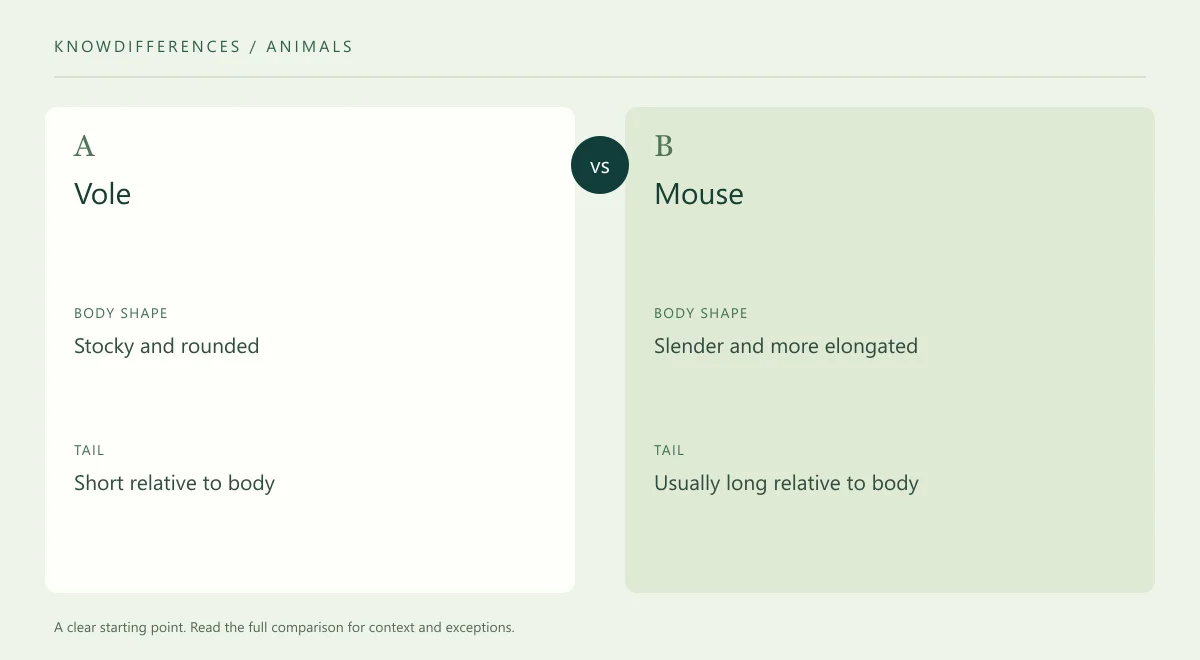
| Body shape | Stocky and rounded | Slender and more elongated |
| Tail | Short relative to body | Usually long relative to body |
| Ears | Small and partly hidden by fur | Larger and more obvious |
| Snout | Blunter | More pointed |
| Diet | Mostly grasses, roots, bark and other plant matter | Seeds, grains and many other foods; often omnivorous/opportunistic |
| Typical habitat | Ground cover, meadows, lawns, gardens | Fields, buildings and many other habitats depending on species |
| Tunneling | Often creates surface runways and shallow burrows | May burrow, nest in cavities or use structures |
| Garden impact | Can girdle stems, eat roots and damage turf | Often damages stored food and may enter buildings |
How to tell a vole from a mouse
Start with the whole animal
A vole usually looks compact, with short legs and a rounded body. A familiar house mouse tends to look more slender, with a more noticeable snout and ears. Size alone is a weak clue: young animals and different species overlap, and a brief view can make proportions hard to judge.
Compare the tail with the body
A vole’s tail is relatively short. A house mouse has a much longer, more conspicuous tail. When an animal is partly hidden in grass, the tail may be the clearest visible difference, but combine it with the ears and body shape rather than relying on a single feature.
Look at the ears
Vole ears are small and can be partly hidden by fur. The ears of a typical house mouse stand out more clearly from the head. A photograph taken from above or at an angle can conceal them, so an apparently earless silhouette does not identify the animal by itself.
Notice where it was found
Voles commonly move through dense vegetation and shallow runways. Narrow tracks through a lawn, especially after snow melts, can be evidence of their activity. Damage to low stems, roots or bark can add context to a sighting.
A mouse found around stored food or inside a building presents a different pattern. However, mice also live outdoors, so “outside” does not automatically mean vole. Location is useful supporting evidence, not a complete identification.
Understand the common-name problem
Voles are sometimes called meadow mice or field mice. Those common names can make two sources appear to disagree even when they describe the same animal. For a local identification, the species name, a clear photograph and the region are more useful than the word “mouse” alone.
Make a practical comparison
If you see a stocky animal with small ears and a short tail crossing a grass runway, a vole is a plausible identification. If the animal has prominent ears and a long tail near stored food, a house mouse is a more plausible comparison. Neither description covers every rodent species, so leave the identification uncertain when the distinguishing features are not visible.
Other practical distinctions
- Tunneling: Vole: Often creates surface runways and shallow burrows. Mouse: May burrow, nest in cavities or use structures.
- Garden impact: Vole: Can girdle stems, eat roots and damage turf. Mouse: Often damages stored food and may enter buildings.
Similarities
- Both are rodents with continuously growing incisors.
- Both can reproduce quickly when food and shelter are abundant.
- Both are prey for owls, foxes, snakes and other predators.
- Both can live near people, although their preferred habitats often differ.
Practical examples
- A compact brown rodent making narrow runways through lawn grass is more likely to be a vole than a house mouse.
- A small rodent with prominent ears and a long thin tail found inside a pantry is more likely to be a mouse.
How to distinguish them in practice
Use several observable clues together—body proportions, tail, ears, behavior and habitat—rather than relying on one feature.
Common mistakes to avoid
- Identifying an animal from size alone; age, sex and viewing distance can mislead.
- Ignoring tail, ear, snout, coat and habitat clues that work better in combination.
- Assuming common names map neatly to one species in every country.
- Handling wild rodents or contaminated material instead of using safe observation and cleanup practices.
Frequently asked questions
Are voles a type of mouse?
Voles are a different group from house mice and the mice commonly placed in the genus Mus. Common names are less precise: voles may be called meadow mice or field mice. Use the species or group name when the distinction matters.
Which has the longer tail?
Mice generally have a much longer, more conspicuous tail. A vole’s tail is comparatively short.
Do voles come inside houses?
They can enter structures, but voles are much more strongly associated with outdoor vegetation and ground cover than house mice are.
Are voles dangerous?
They are mainly a landscaping and garden problem. As with any wild rodent, avoid direct handling and clean contaminated areas carefully.
Bottom line
The most useful first check is body shape: Vole — Stocky and rounded; Mouse — Slender and more elongated.
Sources and further reading
KnowDifferences Editorial Team
Independent explanations with definitions, practical examples and references. Read our editorial approach.